




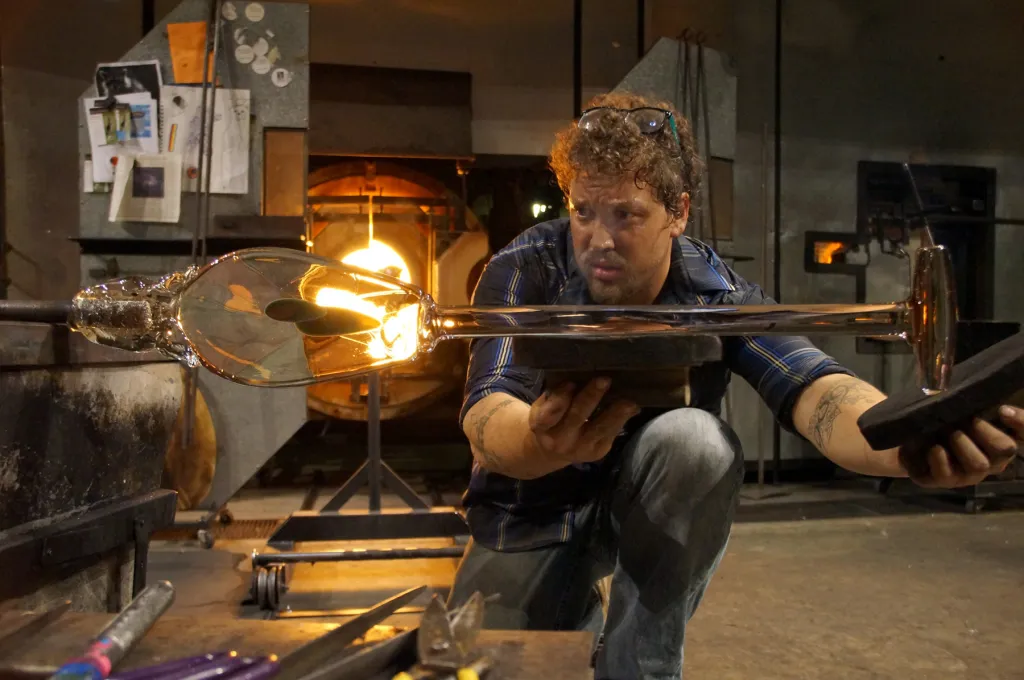
It was 1996, Dan Friday was 20 years old, and working at a tow truck company where he was training to become a repo man. Although his family lineage included a long line of talented artists, he figured art making wasn’t practical, choosing trade school and becoming an auto mechanic and tow truck driver.
Read more Man pleads guilty to attempted murder for stabbing pregnant woman in Mira Mesa
“Then, when I was making a delivery at a glass factory and I saw what they were doing, I just knew I had to do that,” he recalls. “It was like, ‘What are you going to do with yourself?’ is a big question you have as a young person, and it was like a big weight lifted off my shoulders. I just really knew right away that this was going to be my path.”
Friday is a member of the Lummi Nation, his Lummi name is Kwul Kwul Tw, and he’s a renowned glass artist, also working in wood carving and some bronze. His work, which he describes as an intersection of traditional Coast Salish themes in a contemporary glass format, is part of a traveling exhibition, “Clearly Indigenous: Native Visions Reimagined in Glass,” on display at the Mingei International Museum in Balboa Park through Sept. 20. This exhibition showcases more than 100 pieces by 33 contemporary Native American and indigenous Pacific-Rim artists, Australian Aboriginal and Maori artists who have collaborated with Native American artists, plus famed glass artist Dale Chihuly. To formally celebrate the opening of this show, the Mingei is hosting “a day of community and craft” from 11 a.m. to 5 p.m. Saturday, featuring a basket weaving demonstration with Kumeyaay maker Eva Salazar and Wiyapu bird singing.
Based in Washington, he’s won multiple awards for his glass work; held various residencies; taught at museums, colleges, and other institutions; created an outreach program for Native youth at the Pilchuck Glass School; and was a contestant on the third season of the Netflix reality competition, “Blown Away.” He took some time to talk about his work and merging modern glass art techniques with his Lummi culture. (This interview has been edited for length and clarity. )
What was it about working in glass that seemed to speak to you so strongly?
When I first saw glass making, it was in a factory, and I just liked the idea of working with my hands. It’s something I’ve always done, and that’s kind of why I fit so naturally into working on cars, but you’re just fixing people’s problems. When you’re a tow truck driver or an auto mechanic, you’re dealing with everybody on their worst day of the week, so it’s just not a feel-good industry. Making art, you get to be creative and work with your hands and try and make something. As an artist, maybe not everything you make, but you maybe make something that brings someone some joy, or has meaning to it. So, that was the appeal to me, just working with your hands and seeing what could be done. It seemed a lot more productive, and there was a teamwork aspect of it, too, because you work in big teams. Glass blowing is a unique art form. If I was a painter or a poet, I don’t need anyone else to create my artwork; but when I blow glass, especially the style of soft furnace glass that we use, you need a team of assistants or helpers or people to help you come up with your design, help fabricate your design.
When you first started, what was your plan? How did you see yourself using glass in the beginning?
It was a big career change. I had a tow truck when I was 16, so I’d spent most of my teenage years working on cars. I got a car when I was 13 or 14 and I was growing up around cars. My old man was a mechanic and when he was killed, in the Lummi tradition, they burn all your stuff, like all your clothes and photos, so I really only have a handful of pictures of him. But, the one thing they couldn’t burn was his tools, so there was a fight in the family about who got Chuck’s tools, and my uncle held them for me. I was just a little kid at that time (about 3 years old), and I just thought that that meant that I was preordained, or like it was just meant to be that I had to become a mechanic. That’s what I was doing up until I found glass.
I had that single mother life growing up, latchkey kids with my sister (Raya Friday, whose work is also part of “Clearly Indigenous”). She’s also an amazing glass artist. She’s younger, but sort of wiser. She kept my mom from having a heart attack when we were growing up. It’s kind of a funny story: I’d left home, I was 20 and had been gone for four or five years. I was calling home one day and was like, “Hey, let me talk to mom.” We’re siblings, so we grew up fighting a whole bunch and we hadn’t really kept in touch after I first moved out. I’m waiting for my mom to come to the phone and she said, “So, what are you doing with yourself?” I’m like, “Well, I got a job at a glass factory,” and she said, “You [expletive]. I’ve been trying to blow glass for years, but it’s too expensive.” She actually started blowing glass about two years before I did, so I’m like, “Hey, I got this job at a factory,” and I got her a job. That’s kind of our path, we were fortunate enough to share a path together that way. Not that we’re not close, but it definitely brought us together. We still work together and it’s cool to share something like that with your siblings.
After about six months at the factory, I went to the Tulsa Glassblowing School, and that really opened my eyes to the broader glass community because it’s a small community. There are people who do it all over the world, but there’s really not that many people that do it, so even if you’re in Denmark, I may know all about you, or I’ve met you.
Read more Graham Platner withdraws from Maine Senate race, kicking off Democrats’ quest for nominee
When did you begin incorporating your Lummi culture and heritage into your glasswork, and why?
After I’d been blowing glass for about 12 or 13 years, I went and visited my Aunt Fran (James). One of her things is that she’s a Native basket weaver and blanket maker. She’s a real cultural purveyor for the tribe and I remember she said to me, “Hey, I heard you’re a hotshot glass artist, I want to see your work.” I said, “Oh, well, Auntie, it’s so expensive. Everybody in this industry has a degree from somewhere and I just haven’t got there yet. It’s just hard.” And she goes, “Well, I don’t have a degree. I don’t have any of those things and my work is in the Smithsonian.” And, I’m like, “But Auntie, I work for this famous guy, Dale Chihuly. Maybe you’ve heard of him?” And she said, “No, I don’t know who that is, but you can’t wait for someone to give you the keys to the place. You’ve got to just figure out your way to get in.” So, that happened when I got sober about 17 years ago, and I kind of needed a kick in the pants like that to get going. Hurry up and make mistakes. She said, “You don’t need a university’s permission to make your artwork. We make things with our hands, that’s what we do. Start making those mistakes and figure out what you want to do.” I just took it to heart and that was really when I started to buckle down on my work.
I come from a long line of artists. My great-grandpa, Kwul Kwul Tw, where I get my Indian name, his name was Joseph Hillaire. He was a real famous totem pole carver, so I do some glass totems and I make some baskets like Aunt Fran. It’s just a way for me to explore my culture, and a different medium. My great-grandpa’s last totem pole, we just removed one of the most famous ones in Kobe, Japan last year. The last standing one is at the Whatcom County Courthouse, and it’s mostly fiberglass that’s been restored a couple times. It just brings me a lot of pleasure to tell these Coast Salish stories in glass because even though glass is fragile, it’s really permanent. One of my favorite pieces of glass is at the Corning Museum in New York, and it’s the bust of (Pharoah) Akhenaten. It’s one of the first pieces of glass, and it was made, like, 3700 years ago. So, I really enjoy that aspect of working with glass, the permanence.
How would you describe your approach to your glass work, specifically in blending the traditions of your Lummi culture and modern glass art techniques?
The studio art glass movement is this era of independent artists making glass. Originally, glass houses or glass factories would hire a designer to make the designs that glass fabricators would make. So, there wasn’t necessarily an artist behind the work, or the designer. They would hire these famous artists who didn’t really understand how the material worked because they weren’t making it. It wasn’t until the early ’60s in Ohio in ceramics where independent artists sort of figured out to make these mini furnaces and these really small pieces of equipment. Then, they were also the fabricator and the designer, so it just took it to this place where independent artists can also be the maker and not just the designer. That’s what’s called the studio art glass movement.
Natives working in glass is a relatively recent thing. There are 30-plus Natives in this show, and I didn’t realize there were so many. I thought I knew everybody that was doing this work, but I’d never heard of, like, Angela Babby before. She’s got some of my favorite pieces in the show. It’s cool that there are so many Native artists because Native people are just resourceful, like anybody else. They use whatever is available to them. When the jingle dresses were originally done with antlers or shells or beads, as soon as chewing tobacco tin can lids came available, then they started using those to make the dresses. As soon as totem carvers could get steel, the carving equipment became better. I think Native people are just resourceful and use whatever is available to them. That being said, glass is really expensive to do, and only in America did it start this studio movement where you could get in a small shop and work on a team, or get a job at a factory. Fast forward, and now you can go to a fancy university and get a Ph.D. in glass, but I think Native people are just drawn to work with our hands. I’ve worked with my hands my whole life, so once it was introduced to me, it’s just sort of part of my repertoire now.
Can you talk about a couple of your pieces in the Mingei exhibition, and how these pieces reflect some of the stories and traditions of your culture?
I have the Star Basket. I started making the basket series about three months after Auntie Fran died. Her Indian name was Che Top Ie, and she was a really famous basket maker in our community. Her son, Bill James, they were a mother-son team that worked together, and they were big teachers for me. There’s a basket (in this exhibition) called Aunt Fran’s Basket and it’s just in honor of her. There are definitely some of the totems inspired by my great-grandpa, who was really a pioneer in the totem world. He lived in two worlds; he grew up in his dad’s long house, and then he was one of the first people to use chainsaws in their totems and use house paint instead of just traditional paints and dyes. He really made a foundation for Coast Salish carvers today.
Read more Crews are draining the Lincoln Memorial Reflecting Pool again as part of Trump’s troubled revamp