







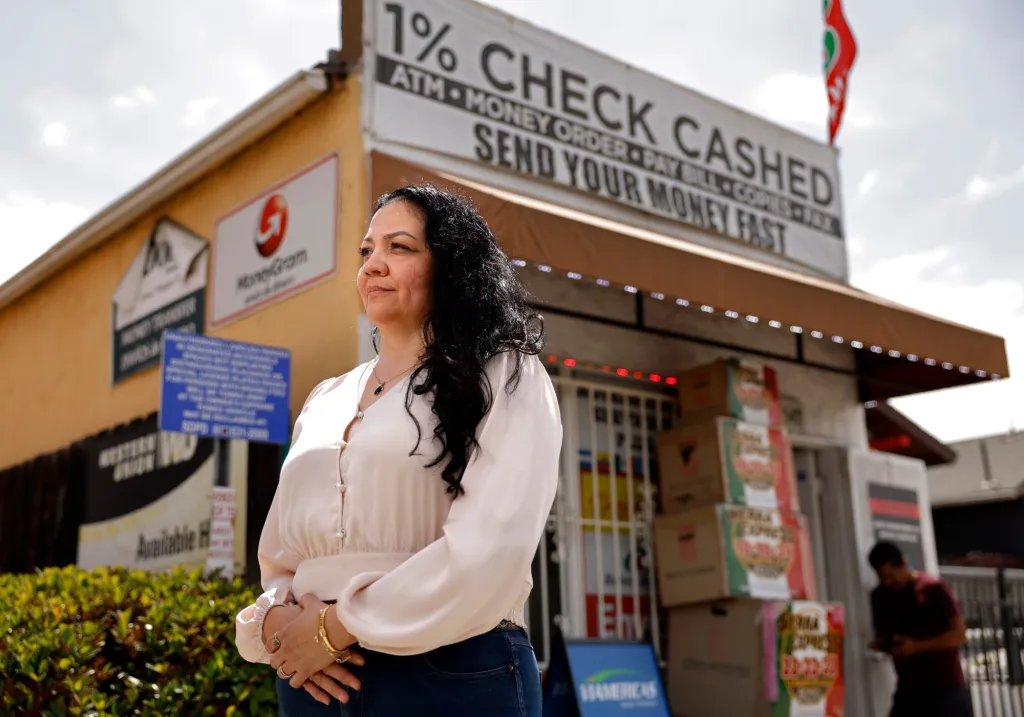
A federal appeals court on Monday upheld a San Diego federal judge’s prior ruling that the Trump administration cannot require money services businesses to report all transactions of $200 or more, a rule the government said was aimed at combatting money laundering but that a San Diego small-business owner argued would financially ruin her company and others like it.
Read more A Reason to Survive (ARTS) names Marisol Alvarado as new executive director
Money services businesses provide check cashing, money transmitting, foreign currency exchange and other similar services and are already required to report all transactions of $10,000 or more to help combat money laundering. But in April 2025, the Trump administration implemented a new rule that required such businesses in 30 targeted ZIP codes in California and Texas to report all transactions of just $200 or more.
Esperanza Gomez Escobar, the owner of Novedades y Servicios, one of the affected businesses in San Diego’s Southcrest neighborhood, quickly filed a federal lawsuit against the Department of the Treasury’s Financial Crimes Enforcement Network, known as FinCEN, the federal agency that had issued the rule.
A week later, U.S. District Judge Janis Sammartino granted a motion by Gomez and her company to temporarily restrain FinCEN from enforcing the $200 reporting requirement. A month later, Sammartino issued a more substantive preliminary injunction to block FinCEN from enforcing the rule. The Trump administration appealed Sammartino’s ruling.
The 9th U.S. Circuit Court of Appeals affirmed Sammartino’s preliminary injunction ruling in its 2-1 decision Monday, agreeing with the San Diego judge that Gomez and her company were likely to succeed on the merits of their case and that they had demonstrated they would likely be irreparably harmed by the rule.
“I am very relieved to have my victory confirmed by the court,” Gomez said in a statement Monday. “If the rule had gone into effect, I don’t think I could have kept my business. I’m also proud that my win has saved many similar businesses.”
The FinCEN rule, known as a “geographic targeting order,” had applied to 30 ZIP codes in California and Texas, including seven in San Diego County. At the time the targeting order was issued, FinCEN said it was aimed at “further (combatting) the illicit activities and money laundering of Mexico-based cartels and other criminal actors along the southwest border.”
But the Institute for Justice, a nonprofit law firm that represented Gomez and her company, had argued that submitting anti-money laundering reports for nearly every transaction would become prohibitively time-consuming and costly. The plaintiffs’ attorneys also argued that because the rule only targeted certain ZIP codes, it would allow anyone wishing to circumvent the reporting requirement to simply go to a business located in one of the many nearby ZIP codes not covered by the new rule.
Read more Mission San Diego to mark 257th anniversary with bell-ringing festival
Gomez and her attorneys had also argued that such reporting requirements would force customers to turn over sensitive information such as their names and Social Security numbers, raising concerns that the Trump administration could use that information in its immigration crackdown. And they argued that “(sweeping) up information about countless everyday transactions” violated the Fourth Amendment.
Ultimately, both Sammartino and the 9th Circuit avoided the question of whether such a rule might violate the Fourth Amendment. Instead, among other findings, the 9th Circuit upheld Sammartino’s prior decision that the rule violated the Administrative Procedures Act.
Andrew Ward, a senior attorney at the Institute for Justice, said he and his firm were thrilled by Monday’s 9th Circuit ruling.
“FinCEN doesn’t have the power to snap its fingers and impose massive new compliance burdens any time it wants,” Ward said in a statement.
Since the litigation began last year, FinCEN issued additional orders that raised the low end of the reporting limit from $200 to $1,000, but also added additional ZIP codes in Arizona and New Mexico.
The Institute for Justice said Monday’s 9th Circuit ruling barring FinCEN from enforcing the rule in San Diego will also cover the new ZIP codes in Arizona, and that two federal courts in Texas have also issued preliminary injunctions against enforcement of the rule.
Read more What to know about Trump’s order shrinking the size of 2 national monuments in Utah