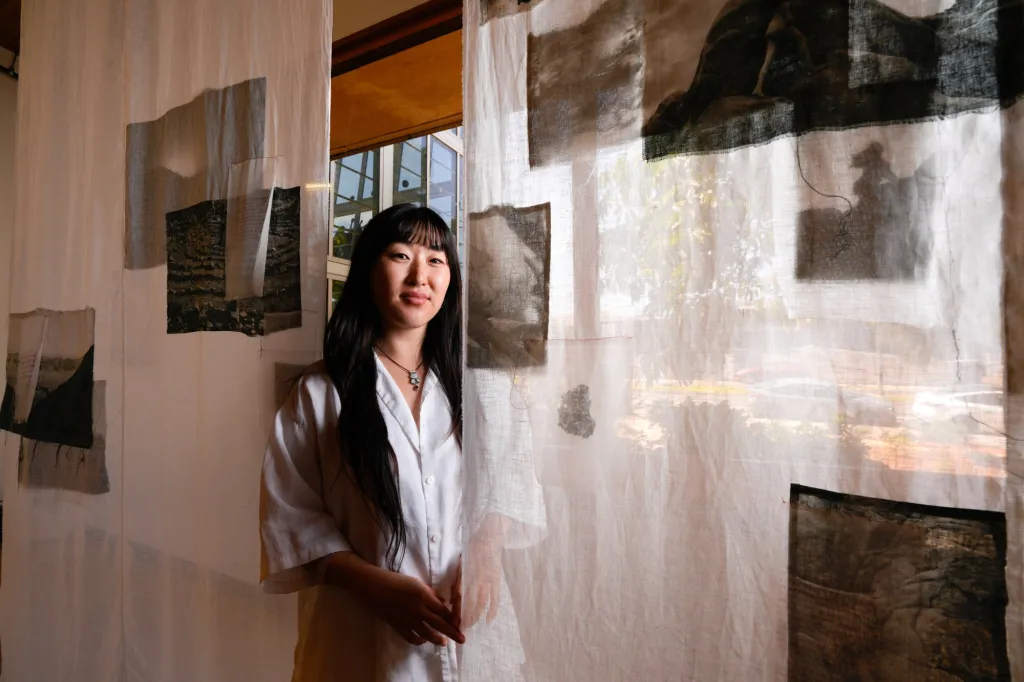
The pandemic brought artist Lucy Mu Li back home to Carlsbad in 2020, where she developed a connection to land, water — to place — she hadn’t experienced before. That new kinship is reflected in one of her recent works.
Read more In Carlsbad, the world-renowned Gemological Institute of America is itself a treasured gem
“That was sort of when I began to really cultivate a deeper relationship with the lands and waters of my hometown, as that wasn’t something I necessarily knew how to have, or had access to, when I was younger and growing up here,” she says. “I began to get to know the land and waters here in a deeper way, and that has been a really strong current throughout my practice since then.”
“Field Notes in the Vortex” is her first artist book, and photographic textile installation, and it’s part of “EROTECH: Expanded Erotics for Reclaiming Aliveness,” the third exhibition of Viet Voices’ San Diego AAPI Emerging Artist Fellowship. The fellowship, funded through a Healing Through the Arts and Nature grant from the Prebys Foundation, works with artists who are early in their careers, providing professional and leadership development, partnering with other artists, and providing a platform for the fellows to develop and present new work. In “EROTECH,” Li is joined by fellows Armaan Mumtaz, Kelsey Boncato, and X in showcasing their latest pieces that include oil painting, video projection, photography, installation, textile work, and new media.
Li, 29, lives in Carlsbad and took some time to talk about her multiple trips to the desert to work on “Field Notes,” questioning what it means to love and care for the land we live with, and finding a more expansive sense of belonging and identity because of it. (This interview has been edited for length and clarity.
Your bio says that you’re Chinese American. What kind of influence has your upbringing and culture had on the art that you create?
I like to think that my culture and my heritage are just this foundational undercurrent in my practice. Even when I don’t think I’m referencing it, it’s just a part of me and pouring into my work, so I think a lot of the visual influences and the ways that I construct my world building through my practice is this way of coming home to my culture and excavating that out of myself and pulling that into my work. In a way, I think my practice has always been a way of finding a way home. As my work has evolved to become more land-based, and growing up and living in Southern California, I think the land and waters here have been so deeply influential to me. I’m also exploring my relationship to where I am as diasporic kin, as a descendant of diaspora and a daughter of immigrants, and what does it mean to build a relationship with where I am as someone who comes from diaspora. I think that’s a big question that weaves through my practice and is part of the way that I cultivate a relationship to where I am.
What has the result been for you? In being here as opposed to being in the land of your ancestors?
Growing up, I never really felt a very strong connection to where I was. I think the way I would describe it is sort of having this feeling of living my life as if I was hovering above the ground for most of my life. When I returned home during the pandemic, that was a period of really building a deeper connection to where I am and getting to know the lagoons and the shoreline in this really intimate way, which has come through a very ritualistic practice of returning day after day, and cultivating this practice of deep listening. I think part of it is growing up here and witnessing the ways that the community around me related to land and place; it wasn’t a love for the earth that I could resonate with since a lot of that sort of manifests in surf culture and beach culture. That, from my perspective, comes from a very settler-colonial gaze, and that was a way of relating to the land that I didn’t resonate with. It also sort of relied on excluding me; I wasn’t a part of that culture. Coming back and building this practice, I got to really grow a love for land that emerged from my own body and my own lived experience. I think part of that is coming into this more universal identity that, wherever I am on Earth, I have this responsibility to the lands and waters that I’m on. I’m being so generously held and loved where I am. There was just this recognition that the land here has generously taken me in, so what does it look like as someone living here without that long, sustained line of ancestry? What does it mean to love the land with a sense of reverence and reciprocity? I think I’m really interested in not necessarily having answers, but interrogating that position and proposing new ways of loving the land that don’t rely on extraction or a settler-colonial gaze, and can be aligned with Indigenous land sovereignty.
It almost sounds like where before you felt like you were hovering, coming back here in 2020 was maybe an acceptance of this place that helped you find a way to root yourself? Is that fair to say?
Yeah, that resonates. It’s sort of like my identity, or my position, in my hometown always seemed to be filtered through the communities that predominantly live here. Coming back older and as an adult, I was able to find a sense of identity and grounding in this place that I’ve grown up with, through the earth and through the land and the water, and not needing that filter through the dominant culture.
Read more As Trump buyouts shake offshore wind industry, states hope developers stay in the game
Can you describe “Field Notes in the Vortex”?
“Field Notes in the Vortex” is my first artist book. It’s a handmade edition of 25 books, and it is a collection of my field notes, both writing and photographic, from sustained periods of time that I’ve spent in the high desert of Southern California. I started making these visits out into the desert several years ago, and came into this flirtation with land that, ultimately, led me to wonder what it would be like to stay a while and really explore that relationship and allow myself to be influenced by the land. Through some artist residencies, I was able to spend extended periods in the desert. I never really set out to make a book; it really was just the product of a process that emerged very intuitively and naturally while I was spending time in the desert. My “Field Notes” are these explorations into more than human conversation and into more expansive experiences of time and space and body, and what I think it means to really live out on the edge of the world and allow yourself to be changed by the landscape. It really just comes from such a deep sense of love for the desert and the kinds of conversations I was able to fall into with the beings of the land, and turning that into my first artist book.
Where did the idea for it come from? What was your process for conceptualizing this piece?
When I was living in the desert, I maintained this writing and photography practice as a way of listening to the land, and also sort of documenting the wisdom that was being distilled from spending time very intimately with the desert. So, over time, I started to just compile a lot of field notes and photographs, and during my second residency in the desert, which was me and my friend organizing a communal residency together living with seven other artists, and together we organized a culminating exhibition. For that exhibition, I made a little ‘zine and that was the first iteration of this book. It was like a printer paper ‘zine with some of my photographs and field notes from my time in the desert. I think that was when I began to realize that I was onto something and that it was the project I wanted to deepen and continue, the conversation that I wanted to keep having and see what would happen. So, I organized another residency in the desert. I did a residency at High Desert Test Sites with A-Z West (the organization is based at artist Andrea Zittel’s 80-acre compound and artwork) in 2025, which was my third time living in the desert for about a month. I didn’t know how to make a book at all beforehand; I did a residency at Kala Art Institute, which is a really wonderful communal print studio in the Bay Area, and that was when I began doing research into bookmaking, did some more tests with bookmaking, and started going through my archives and organizing and figuring out what story was emerging from all my field notes. With the support of the fellowship, I was able to turn that into my first edition of books.The first time I did an artist residency in the desert was in 2023 at Jackrabbit Studios in Landers, Calif. I was there during the spring, from April through June, and at that time, I didn’t even really know that I was working on this project. I was just sort of in the initial stages of collecting field notes and writing and photographing and building that connection with the land. The next time I was there, I spent six weeks in the winter of 2024, also at Jackrabbit Studios with a community of artists. The third time that I was living in the desert, I was doing a residency at A-Z West with High Desert Test Sites in the winter as well.
What did you see, hear, smell, and feel during these trips?
I saw so many endless horizons. I could hear this depth of silence that I think really was astonishing. It’s really fascinating the way that when you experience that kind of depth, it really changes the way that you understand your body and relationship to the world. I think there’s such an intimacy to feeling your presence, in that way, with a landscape that’s so vast. To feel yourself both so alive and also so small.
The smell that’s coming to mind, which is my like favorite smell of the desert, is after it’s rained, which is obviously rare. All of the colors in the land are deeper; there are these reds and purples that become more rich in the land. I’m thinking of the buckwheat plant that’s kind of red, and after it rains, it’s this beautiful, rusty red color. I’m thinking of creosote buds and the way that the buds are these white, fuzzy pearls. They’ll hold the rain droplets in this really beautiful way. After it rains, there’s such a deep sense of gratitude that’s just emanating from the earth, and you can really feel it in your own body, too, that sense of gratitude. I can also feel the wind on my skin, which can vary so vastly from being such a soft, gentle caress, to these really powerful windstorms that will literally shake the walls. You can just feel such a sense of wilderness and aliveness.
On your website, you say that you are “a land-based artist and Earth linguist, a translator amongst kin. My work emerges through intimate conversations with Earth, working across mediums to weave stories of more-than-human kinship and interconnectedness.” What is an Earth linguist, exactly?
I think “Earth linguist” is a term that I’ve sort of invented because it feels fun and kind of nerdy to me. I think it’s a budding name that I have for a way that I’ve been in conversation with the Earth in my practice. At the core of what Earth linguistics is to me, is just a devotion to learning more than human language and integrating that into my own language as a way of expanding my conception of the world. From being in this human myopia, to bring more than human perspectives into the fabric of how I experience the world. I think, in doing so, it really transforms the way you understand time and perspective. As part of my drawing and painting practice, I love to document the textures I see in the land, and then use drawing and painting as a way to learn those textures as a kind of language and interpret meaning from them, and then weave them into my own vocabularies and sentences. I think this practice has really allowed me to come into an intimacy with the world that has made me feel closer to the world around me in a way that’s really transformed me. There’s so much healing that is possible when we, as human beings, begin to break down those boundaries and barriers between us and the more than human world. I think building that intimacy is, ultimately, what allows us to feel more alive and more connected.
When did you first notice feeling drawn to converse with the land, with Earth? And, how do you approach your intimate conversations with Earth?
I think I can trace that back to when I first moved back to Carlsbad during the pandemic, and began my land-based practice of coming into this ritual of returning to this very specific stretch of beach that I really loved (Stone Steps Beach in Encinitas), and going day after day, and really feeling like I was entering this very epic and beautiful conversation. Seeing it as my role to listen closely and pay attention and learn what it means to become a part of this conversation. For me, it was such a deeply healing process because I think I’ve found a very deep sense of belonging through it; through this careful listening and witnessing and integrating these languages into my own visual language and way of being in the world. I came into a sense of belonging with the broader story of Earth, and I think for a lot of my life until then, belonging was something that was felt very tenuous, or ungraspable, within the systems that we live in. The systems of power and hierarchies and supremacies that we live within, there’s so much of these external definitions of what it means to belong, and I think through that conversation I was able to find a sense of identity and belonging that was much more generous.
Read more Outdoors: Secret Spring camera captures a curious bobcat