






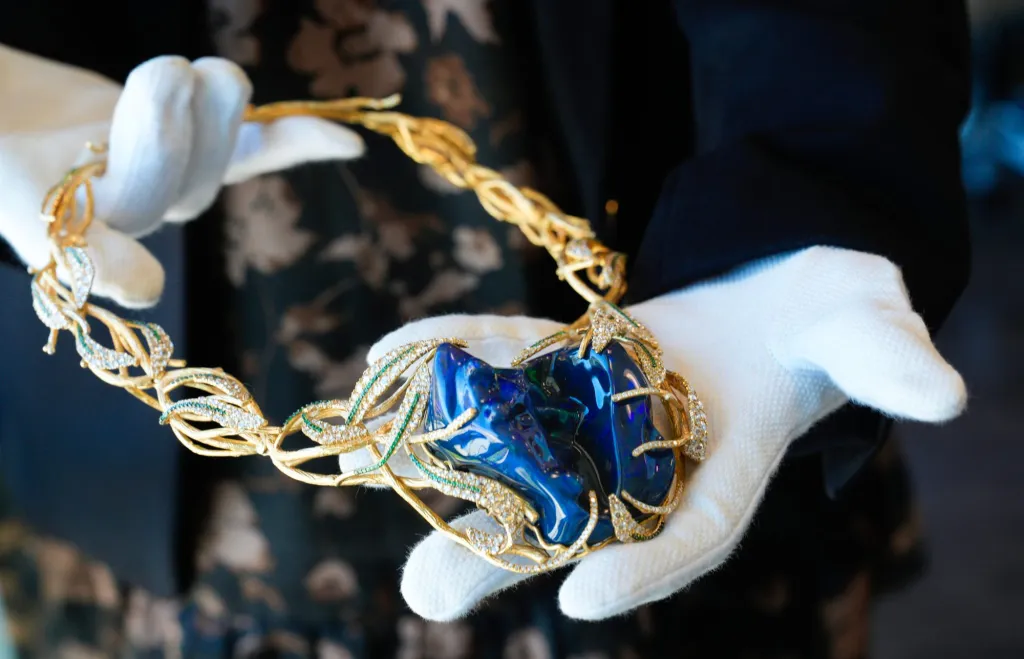
It’s a sunny Thursday morning in Carlsbad and the lobby of the Gemological Institute of America is hopping with activity. Up and down the stairs and in hallways, students in its highly coveted gemology graduate programs walk to and from one classroom to another. Down one hall from the lobby, peek through a small glass window, and you can see children from area schools looking into microscopes to examine gems.
Read more As Trump buyouts shake offshore wind industry, states hope developers stay in the game
It’s just another day at the Gemological Institute of America in Carlsbad, the worldwide headquarters of one of the leading authorities — make that the leading authority — on diamonds, colored stones and pearls. GIA, as it’s more commonly known, oversees a vast network of laboratories, campuses and research centers all over the world.
The massive campus on Armada Drive — an unassuming building off Interstate 5 — is the nerve center of an operation that stretches from Carlsbad to gem and jewelry centers across the globe, from New York to London, Mumbai to Bangkok, Johannesburg to Tokyo, analyzing 4 million gemstones every year.
Drive past the GIA campus, and it’s not immediately evident that the buildings contain some of the world’s most valuable gemstones and that the institute has been behind the identification or appraisal of some of the planet’s most famous gems, including the Hope Diamond, a 45.52-carat grayish-blue diamond first mined in India and passed through French royalty and English collectors before landing in American hands in 1949. Jeweler Harry Winston donated it to the Smithsonian Institution in Washington, D.C., where it’s now on display.
‘Living museum’
Unlike many specialized labs, GIA’s strength lies in its strong grasp of the world of gemstones — from field research to education to laboratory analysis. Besides being a research center and a school, GIA is also “a living museum, and we have over 100 exhibits spread throughout the campus,” says Rachelle Turnier, GIA’s manager of museum and in-kind gifts.
The exhibits are meant “to educate our public, our students and our employees — to create a space that people can come and enjoy and also see minerals in their rough form, in their cut form, in jewelry.”
The exhibits — free and open to the public but only by appointment — are spread out across the Carlsbad campus and feature thousands of artifacts and jewelry pieces. Most of the items on display are from GIA’s own collection, while some are on loan from other institutions or collectors.
“We’re blessed to have a number of really big collectors that are local to us,” says Turnier, who recently co-curated, with GIA curator Terri Ottaway, an exhibition titled “Temples and Treasures of Southern Asia” in the rotunda off the lobby.
At other institutions, gems and jewels often remain locked in safes and vaults. At GIA, the exact opposite happens. Because it’s an active learning institution, Turnier says, “our collection is one of the most used museum collections because we use it for research. … We also take pieces up to the classroom so we have jewelry design classes look at them. … So we’re really blessed to have this collection that can be used in so many different ways.”
Massive collection
GIA’s collection comprises nearly 50,000 pieces — rubies, emeralds, sapphires, diamonds and more — with about 1,500 on display. The rest are locked away but brought out for research and educational purposes. Asked about the overall value, representatives declined to say for liability reasons.
“Over 75% of our collection has been donations over time — donations from industry clients, collectors or past students,” Turnier says. “People come here and they know that their treasures will be treasured by other people through our exhibits or used in the classroom. Many of them are people who want to give back to GIA because of what we do for the industry.”
Toward the back of the lobby, there’s a collection of red, white and blue gemstones arranged to celebrate America’s 250th birthday. For the display, “we pulled together all of these gems in the colors of funky reds, whites and blues,” Turnier says. There are bright red rubies — including a ruby carved to look like Abraham Lincoln — and some stones that are actually quite rare, like red beryl, which is one of the rarest minerals.”
Outside GIA’s main building is a statue of Richard T. Liddicoat, Jr., known as the “father of modern gemology.” After holding various positions at GIA, Liddicoat was named its president in 1952, a position he held until 1983, when he became chairman of the institute’s board of directors. Liddicoat created the modern grading standards for diamonds and was instrumental in expanding GIA’s reach across the globe.
“He’s considered the founder of modern gemology,” Turnier says. “He really modernized and turned gemology into a science and had a mineral named after him” — liddicoatite, a rare and vibrant mineral that’s part of the tourmaline family.
Read more Outdoors: Secret Spring camera captures a curious bobcat
A few feet away from the statue of Liddicoat, just past the entrance doors, is The Bahia, billed as “the world’s largest pendant.” Made of rutilated quartz, the 426-pound sculpture hangs from the ceiling in one corner of GIA’s lobby. Carved from an 800-pound crystal found in Brazil, it took carvers Glenn Lehrer and Lawrence Stoller seven years to create.
The Bahia’s location in the lobby was by design. During the equinox — spring and fall — “the sun comes straight through that window,” Turnier says, pointing to glass windows behind the pendant, “cracks through the quartz and shoots a rainbow of stars. So they specifically aligned and built this gallery just for this experience twice a year.”
Gems throughout history
Throughout the campus, display after display showcases GIA’s vast collection of gems and, perhaps more importantly, its deep well of information, from how stones are mined to a specific jewelry’s place in history. On the walls, there are timelines and charts, all designed to educate students and the public about gemology.
Did you know, for example, that just 45 miles away from GIA’s campus is one of the world’s most famous tourmaline mines? The hot-pink variety of the tourmaline found in Pala, an unincorporated community in northern San Diego County, caught the attention of Empress Dowager Cixi, the de facto ruler of China’s Qing dynasty — so much so that she had 120 tons mined in San Diego County and exported to China between 1902 and 1910.
“She had it fashioned into jewelry, snuff bottles and carvings,” Turnier says, “and actually when she passed away in the early 1900s, the mines closed for a period of time because their main and pretty much only customer had disappeared. Nowadays they’ve revitalized the mines, and you can have a dig where you can go and sift through the gravel and try and find a tourmaline of your own.”
Turnier’s a walking encyclopedia, rattling off facts about diamonds one minute and then talking about an Elizabeth Taylor bracelet the next.
Just around the corner from the bracelet? “Oh, there’s this tiara I want you to see,” she says.
“This is one of our most spectacular pieces that was recently donated, just last year. It’s called an aigrette, which is a type of tiara that’s meant to hold an egret feather, as you can see in the back there. This piece is unsigned, but it was fabricated around 1900 and true to the time, it is fully convertible.
“You can take off this band here, you can take this off, you can disassemble this. It becomes a hatpin. It can become a brooch, it can become a pendant, and so this custom. The case was actually created for it, and there are components behind it that allow you to convert into the different pieces. There’s all kinds of fine mechanisms in it, and so they were making things like this back in the day before they even had any of our modern tools just with basic hand fabrication techniques.”
GIA’s exhibits, Turnier says, are really designed to accomplish two goals: “We create these exhibits for the public to admire but also to educate the students. To reinforce everything that they’re learning in class and show them different examples of what they’ll see out in the trade.”
“All our students are learning a profession. They’re learning how to handle gemstones. They’re learning about designing jewelry. Most people come here, and they don’t even know that sapphire occurs in more than one color. They think, ‘Oh, I thought sapphire was just blue’,” says Turnier, who received her doctorate in geoscience from the University of Wisconsin in Madison. Her area of expertise? Sapphires, specifically Montana and Burmese sapphires.
“There is no other organization that does all the things that we do,” Turnier says. “There are other gem analysis laboratories. There are other gem education organizations, and there are some gem research organizations, but there’s no one who does all three.”
Gemological Institute of America
5345 Armada Drive, Carlsbad
Free, but reservations are required.
800-421-7250
gia.edu/museum-tour-reservations
The Gemological Institute of America’s next exhibition, “Earth to Elegance,” will open in 2027.
Read more Michael Smolens: Scripps studies point to possible relief and recovery from future El Niños