








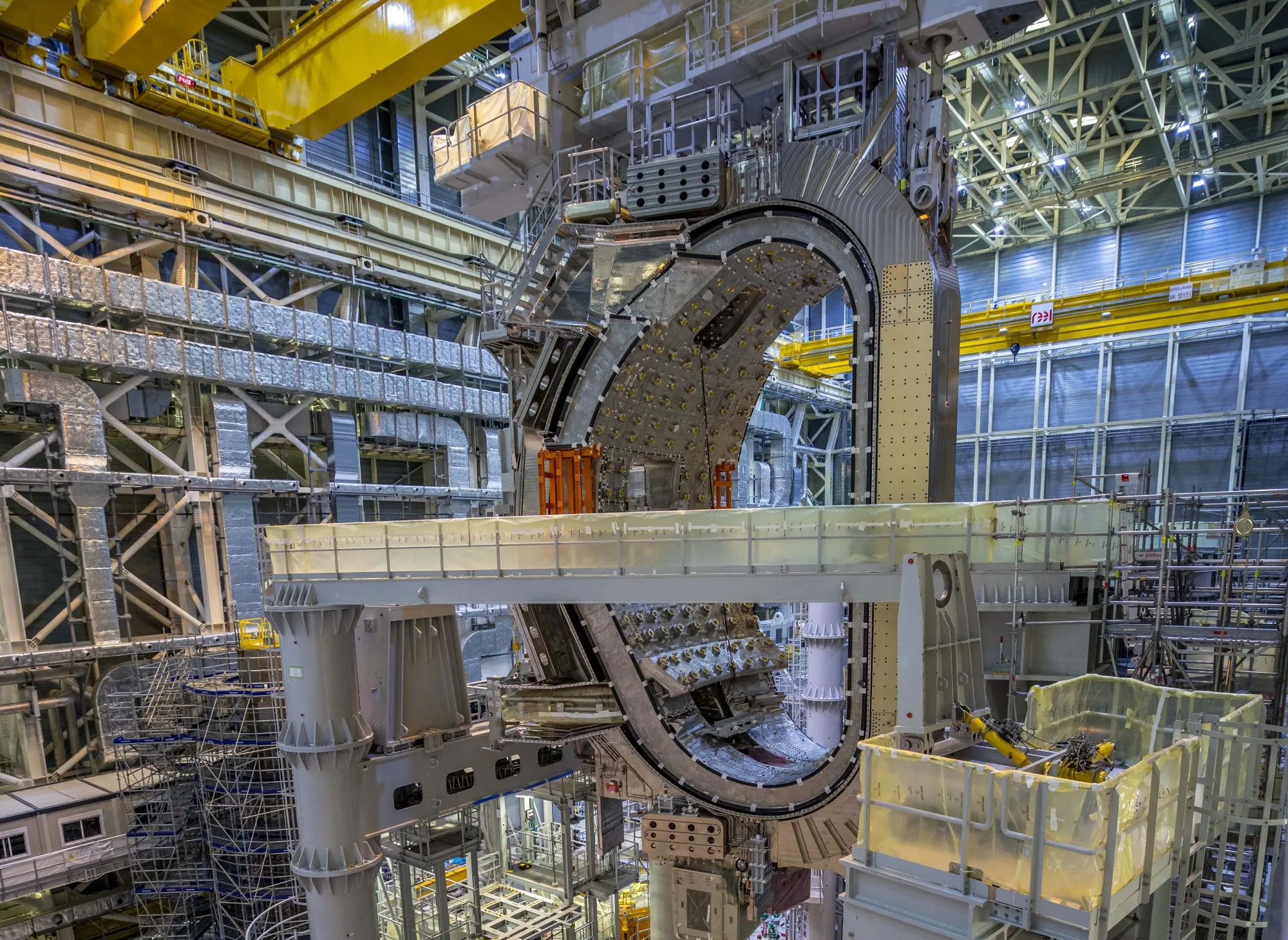
A massive nuclear fusion project in France recently completed inserting six critical sector modules built and tested by San Diego-based General Atomics that form the core of ITER — an ambitious international effort to try and unlock the vast potential of fusion as a global energy source.
Read more Beachgoers encouraged to swim near lifeguards this weekend
Stacked atop one another, the modules make up what’s called Central the Solenoid — described as the largest and most powerful pulsed superconducting magnet in the world.
ITER officials said the 1,100 metric-ton sector was successfully lowered into the heart of the facility on Tuesday in an operation that took 30 hours.
“Seeing all six Central Solenoid modules stacked at ITER is a proud and deeply meaningful moment for everyone at General Atomics who spent nearly 15 years building and testing these extraordinary modules here in San Diego,” Anantha Krishnan, senior vice president for General Atomics Energy Group, said in an email to the Union-Tribune.
“This milestone brings together years of innovation and international collaboration in a machine designed to demonstrate fusion on an unprecedented scale.”
Engineers and researchers have called the Central Solenoid “the beating heart” of the sprawling 445-acre ITER facility, which is still under construction and expected to start experiments in 2034.
The modules were designed by General Atomics and the Oak Ridge National Laboratory in Tennessee.
In stages, each 270,000-pound module was hauled away from the Poway campus at General Atomics by a specially built truck to the Houston Ship Channel and then shipped across the Atlantic to Marseilles, France, and then taken about 45 miles to the ITER facility.
“With six modules now in place, we are demonstrating that this technical approach is delivering tangible results on the project’s critical path,” said .
In addition to the stacked modules that were lowered Tuesday, a seventh module was also constructed and shipped to ITER to use as a spare, if needed.
The sector modules are one of nine that will go into ITER’s tokamak — a doughnut-shaped vacuum chamber surrounded by powerful electromagnets.
The Central Solenoid at ITER is designed to generate a powerful magnetic field that steers and shapes an intensely hot, energy-producing plasma that looks like a cloud. When the hydrogen plasma reaches 150 million degrees Celsius (more than 300 million degrees Fahrenheit), fusion occurs.
That temperature is 10 times hotter than the core of the sun.
Pronounced “eater,” ITER is not a power plant. Rather, it’s a research project that looks to pave the way for the development of facilities that could use fusion to generate electricity.
Read more Photos: The Grade fire
A coalition of 35 nations is contributing components and expertise to ITER, including South Korea, Japan, the Russian Federation, China and the 27 members of the European Union.
The U.S. contribution makes up about 9% of ITER’s costs, but the U.S. will receive access to 100% of the project’s data and intellectual property, which would prove valuable in the development of future fusion programs and potential power plants.
The promise of nuclear fusion as an energy source has fascinated scientists, engineers and entrepreneurs since the 1950s.
Fusion is not to be confused with nuclear fission, which generates electricity at commercial power plants such as the now-shuttered San Onofre Nuclear Generating Station. Unlike fission reactors, fusion leaves behind no long-lived or highly dangerous radioactive waste.
If harnessed, energy from nuclear fusion could produce an almost infinite source of power that emits no greenhouse gases, its supporters say. But as an energy source, fusion power has been generated only for very short periods in the laboratory and no commercial reactors exist.
There’s a long-running joke in the energy industry that commercial fusion is always 30 years away.
But a surge of billions of public and private dollars has been directed at fusion projects, igniting hope that fusion power can become a reality in the next decade or two.
Earlier this week, Massachusetts-based Commonwealth Fusion Systems announced raising $1 billion in its latest round of funding.
Up in Northern California, scientists at the Lawrence Livermore National Laboratory made headlines in late 2022 when 192 high-powered lasers created “net energy” via nuclear fusion reaction. It marked the first time that a fusion experiment resulted in a greater amount of energy coming out than the amount put in.
General Atomics is considered a pioneer in fusion research.
The company assisted in the Lawrence Livermore experiment and GA’s Torrey Pines campus is home to the DIII-D National Fusion Facility that the company operates on behalf of the U.S. Department of Energy’s Office of Science. Pronounced “dee-three-dee,” DIII-D boasts North America’s largest operating tokamak.
Each module shipped to France is 7 feet high, 14 feet in diameter and surrounded by 3.6 miles of conductor segments with six layers of insulating tape that total more than 180 miles.
Put together, the six modules form a colossal magnet nearly 60 feet tall, 14 feet wide and weighing more than 1,000 tons. Scientists at GA say the magnet is powerful enough to lift an aircraft carrier out of the water.
Read more Del Mar Fairgrounds train platform, track and new bridge now fully funded