




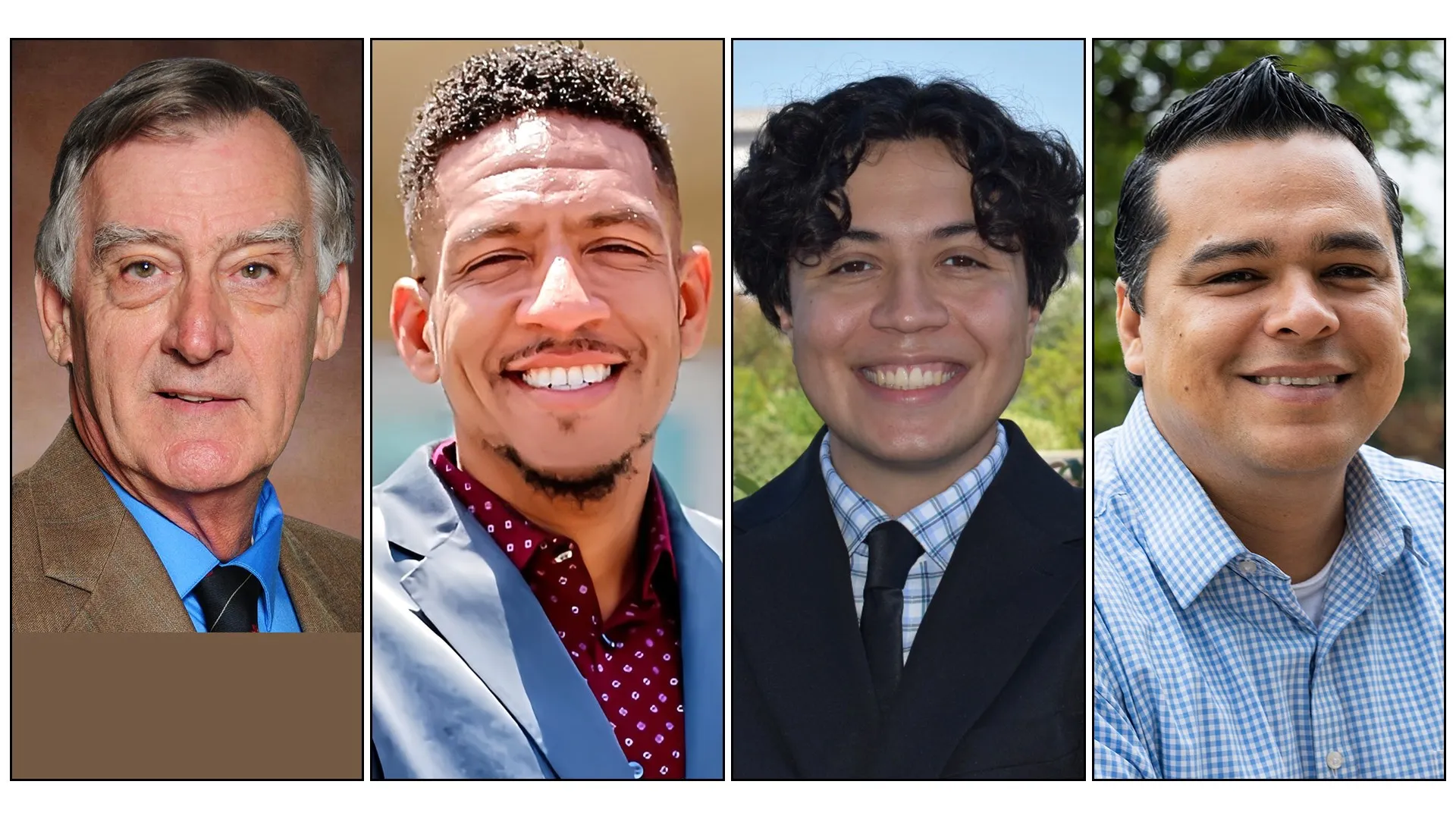
Four candidates are running to lead National City in the Nov. 3 election. The winner will take over a city grappling with a significant budget shortfall, years of staff turnover and a City Council marked by public division.
Read more Stayin’ Alive: San Diego County trains more than 1 million in bystander CPR
Sitting Mayor Ron Morrison is not among the candidates. Two sitting council members, Marcus Bush of District 4 and Jose Rodriguez of District 2, are running for the seat, and they have publicly split over how to close the city’s budget gap, a focal point of this race.
Bush, a city planner and council member since 2020, is running on fiscal accountability, homeownership and bayfront development. Rodriguez, a former labor organizer also first elected in 2020, is campaigning on new revenue for city services and protections for working families.
Former City Treasurer Mitchel Beauchamp is making a bid to return to elected office. And Jacobb Castrejon, a STEM enrichment instructor, is presenting himself as a candidate unaligned with either side of a divided council.
In the interest of consistency, each candidate was asked the same three questions: how to address the city’s budget shortfall; how to handle staff turnover and division on the council; and how to ease the rising cost of living for residents.
Each candidate was also given the opportunity to raise an additional issue of their choosing.
Mitchel Beauchamp
Beauchamp, 80, a biologist who has owned Pacific Southwest Biological Services Inc. since 1974, is a longtime figure in National City government. He served on the City Council and spent nearly two decades as city treasurer.
On the budget, Beauchamp said the shortfall stems largely from new spending approved without identified revenue. He said most council members treat reserves outside the designated reserve fund as available money, and that some “represent special interests who have no concern with City finances, only salary increases or guaranteed union jobs.”
He predicted staffing cuts and delayed raises for remaining employees, as in past budget crises. He noted those measures are offset by workers leaving for other cities.
“There is no easy solution,” he wrote.
On council division, Beauchamp said council interference has “usurped” the city manager form of government, citing heavy turnover in management in recent years. He wrote that what happens in closed council personnel sessions “would make any voter retch.”
He placed responsibility on voters, criticizing those who support “the candidate with the most yard signs.” He noted that three candidates “have free rides” because they keep their current seats if they lose. He wrote that the Nov. 3 vote “will not cure the problem” and that a recall “may be in the offing to purge this plague.”
On cost of living, Beauchamp opposed raising business or sales taxes. He argued business taxes raise prices for consumers and higher sales taxes drive shoppers to neighboring cities. He said rent control “just drives away investment in housing, leading to deterioration of the housing stock.”
He described the cost of living as largely a regional, state and federal issue, with the city’s influence limited to permitting. He also cited discord at the federal level, which he said has no local resolution.
As an additional issue, Beauchamp said many approved multifamily projects sit undeveloped because of a “wishful funding fantasy.” He proposed requiring a timeline as a condition of development approval, and speeding up ADU construction with legal access that would allow future subdivision into separate parcels.
Beauchamp served on the National City Planning Commission from 1985 to 1988 and on the City Council from 1994 to 2002. He was the city’s appointed representative to the Sweetwater Authority from 2002 to 2006 and city treasurer from 2006 to 2025. He holds master’s degrees in botany and biology and served as a U.S. Navy officer from 1968 to 1970.
Marcus Bush
Bush, 38, a city planner and lifelong National City resident, is seeking the mayor’s office after six years on the City Council.
On the budget, Bush said the council must take responsibility.
“The Council’s job is to own this,” he wrote. “We approved the budgets, so we have to fix them, and we have to be transparent with residents about how we got here.”
He said the council approved historic raises for city employees, including firefighters, after the city manager assured members that staff would return with a plan to cover the cost. He said the council approved the raises without that plan, and the city spent a significant portion of its unassigned fund balance to pay for them.
“That ends now,” he wrote.
Bush said he supports the new city manager’s approach. That includes monthly public spending reviews, priority-based budgeting, tighter control of overtime and a hard look at legal and consulting costs. He also called for a restructuring that targets management positions while preserving rank-and-file jobs.
He said that restructuring should start with the council’s own budgets. He said those $100,000 budgets have paid for turkey giveaways, political consultants hired during election cycles, and promotional materials featuring individual council members. He said he is open to suspending the mayor and council budgets until those issues are addressed.
On revenue, Bush pointed to short-term options such as parking meters, facility rentals and longer hours for live entertainment. He also backs a reformed business license tax, developed with input from businesses, for a 2027 special election. “Trust first, then the conversation on reform,” he wrote. He ruled out closing the library, pool or senior nutrition center, and ruled out cuts to public safety.
On governance, Bush said stability starts with the council “staying in its lane of responsible oversight.” He argued that good people leave when council members go around the city manager to direct staff. He pledged an annual council goal-setting workshop so staff work “from one set of priorities, not five.”
Bush wrote that “disagreement is healthy, personal conflict is not.” He said he has disagreed with nearly every colleague, including Morrison, and has worked with all of them to get things done. “The mayor is one vote of five,” he wrote.
On cost of living, Bush noted that two out of three National City households rent. He called for more condos and townhomes to be built through streamlined permitting, a restored first-time homebuyer assistance program, use of city-owned land for homeownership and easier approvals for ADUs.
Read more At The Nat, a decade of discovery under Judy Gradwohl
“A city can’t set the price of gas or groceries, and I won’t pretend otherwise,” he wrote. He said the city can keep fees in check, protect senior nutrition and food distribution programs, and improve transit and safe routes for biking and walking.
He closed his responses by pointing to the bayfront Balanced Plan, which he said would bring more park space, new hotels, public access to the waterfront and hotel tax revenue.
“I want National City to be known for what it’s building,” he wrote.
Bush served as vice mayor in 2022 and 2025. He previously chaired the National City Planning Commission, becoming the youngest chair in city history. He owns Marcus Bush and Associates LLC, a planning consulting firm. He holds a bachelor’s degree in city planning and Spanish from San Diego State University and a master’s degree in real estate development from Portland State University.
Jacobb Castrejon
Castrejon, 25, a STEM enrichment instructor, is making the case that he can bridge a council he describes as split into two factions.
On the budget, Castrejon blamed the deficit on “the lack of long-term planning by the City Council.” He said he would aggressively pursue state and federal funding while streamlining “any bloated departments.” He said he is open to an environmental tax on businesses whose pollution significantly affects community health.
“Cuts to the budget would be a last resort for me,” he wrote. Even then, he said, he would preserve funding for the Engineering & Public Works department to maintain roads. He also pledged no cuts to services for impoverished, disabled and elderly residents.
On governance, Castrejon said the council’s two factions are “separated by professional and personal vendettas against one another.” He called that “toxic culture” a major reason for turnover in city government. “I see myself as the only candidate that has no stake in either faction,” he wrote.
He said his background in social psychology has given him the tools to mediate between the factions. “I will spearhead the effort to create the only faction that should matter and it’s the one working to uplift National City,” he wrote.
On cost of living, Castrejon proposed a four- to five-year moratorium on rent increases, which he said would give stability to the city’s large population of renters. He also said he would explore a city-supported grocery cooperative or other community-based model to offer more affordable groceries and basic necessities.
As an additional issue, Castrejon highlighted the climate crisis, which he said is “on our doorstep,” citing uncharacteristic heat waves in San Diego. He said he would champion National City’s transition to a more sustainable city with infrastructure that can withstand climate disasters.
Castrejon previously worked in state Sen. Steve Padilla’s South Bay district office and served as vice chair of CALPIRG Students’ UC San Diego chapter. He attended Southwestern College and holds a bachelor’s degree in social psychology from UC San Diego.
Jose Rodriguez
Rodriguez, 40, is a council member and small business owner making his second run for mayor after running and losing a hotly contested race in 2022.
On the budget, Rodriguez said the council’s recent hiring freezes are not enough and cannot be sustained. He cited a $13 million deficit that he said the city manager projects will grow to $30 million by 2029. He also cited a city study showing National City collects $130 per business, compared with $891 in Carlsbad.
He said staff brought forward a measure that would have raised about $7 million a year for 911 response, fire protection, senior meals, libraries and parks.
In a split 3-2 vote, the council voted not to place the measure on this November’s ballot, instead deciding to work with the National City Chamber of Commerce to reform the proposal in a manner more accommodating to businesses, eyeing a 2027 special election. Bush, along with Morrison and Councilmember Luz Molina, voted to work with the Chamber. Councilmember Ditas Yamane voted with Rodriguez to place a measure on the March 2028 ballot.
“I am going to keep fighting for working families in National City, and that includes constantly working to find common ground with my colleagues,” he wrote. “Our city has the lowest household income in San Diego County, yet our budget is propped up by the highest sales taxes that our families pay every day.”
On governance, Rodriguez said the city now has a city manager and city attorney who are “laser-focused and professional.” He said the council should set clear priorities, support staff and let professionals manage. He also said new revenue is needed to end the hiring freeze and recruit top talent.
“The division on the Council is unacceptable, and our residents deserve a Council that represents them,” he wrote.
On cost of living, Rodriguez pointed to his record on the council: freezing mobile home rents, raising the minimum wage and adding 240 affordable homes. “I know what it means when the rent goes up and the paycheck doesn’t,” he wrote.
He proposed stronger tenant protections and rent stabilization, affordable homeownership on city-owned land, local hire and project labor agreements on city and bayfront projects and partnerships to help families claim state tax credits and help with utility bills.
As an additional issue, Rodriguez highlighted federal immigration enforcement, citing videos of ICE agents “brandishing weapons at protesters.”
“As a father, I am scared. As an elected official, I am motivated to take action,” he wrote. He proposed making National City a “Rapid Response City,” with an opt-in network that would alert residents to reported ICE activity.
Rodriguez was elected to the council in 2020 and re-elected in 2024. He previously worked as a labor organizer. He holds an associate degree in history from San Diego City College and also lists San Diego State University in his education.
Read more Questions linger as San Diego’s battle-tested carrier USS Abraham Lincoln nears home