


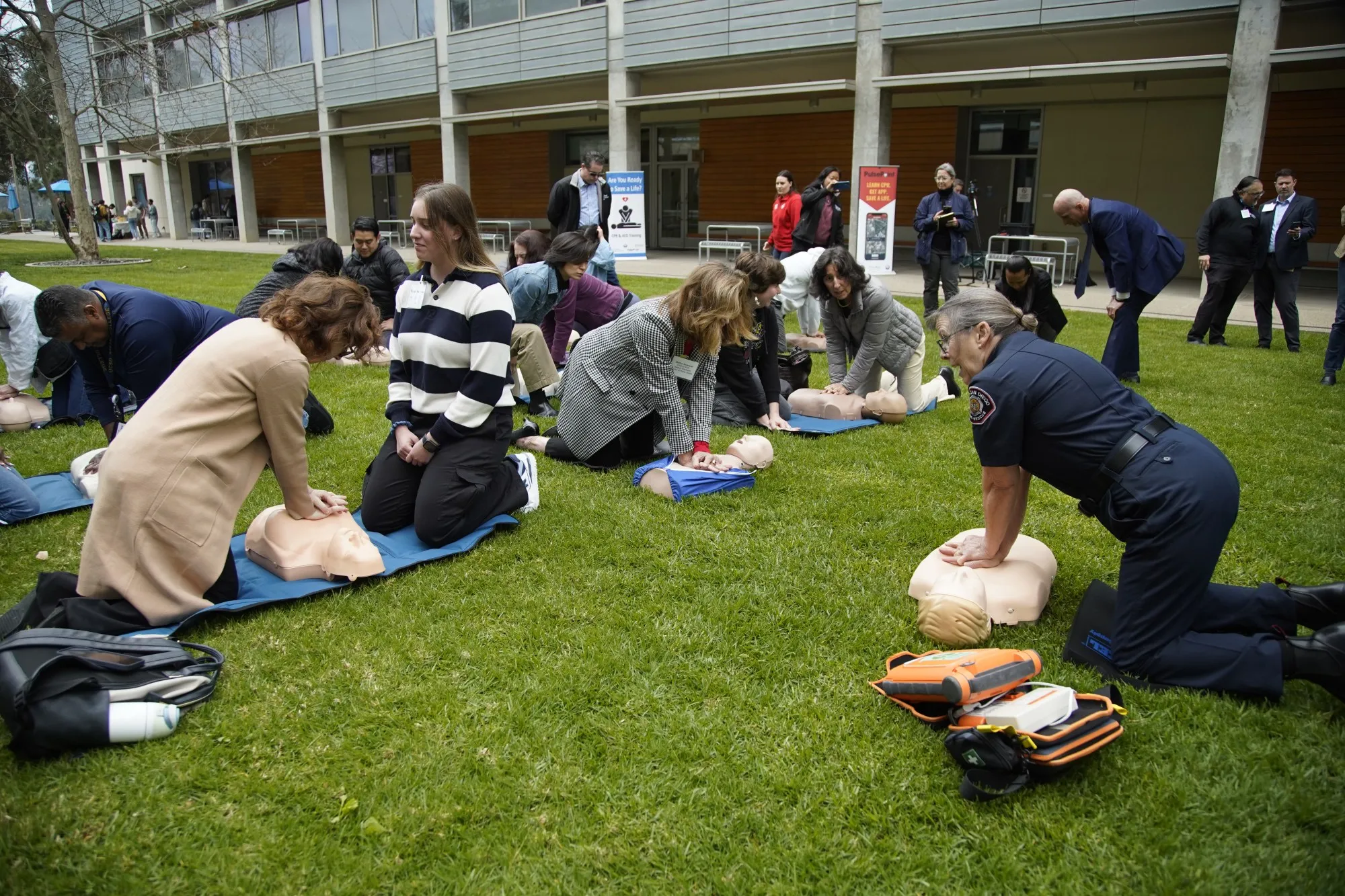
When a crowd gathered at the UC San Diego School of Medicine in February 2024, dancing to the immortal Bee Gees disco anthem “Stayin’ Alive,” organizers thought they could bump and hustle their way toward training 1 million residents in bystander CPR by the end of the year. But as 2026 arrived, that goal remained unreached.
Read more At The Nat, a decade of discovery under Judy Gradwohl
But the Revive & Survive program, like the tunes it uses to help participants pace their chest compressions, has had staying power, crossing the 1 million threshold in August. As public health efforts go, reaching nearly a third of any population, but especially of San Diego County’s 3.3 million residents, is a major accomplishment. By comparison, only 11% of residents received the 2025-26 COVID-19 vaccine.
A joint effort of UCSD’s Herbert Wertheim School of Public Health and the San Diego County Emergency Medical Services Office, Revive & Survive has no plans to slow down, said Kristi Koenig, medical director of the county emergency medical system.
“Yes, we’ve surpassed our 1 million goal, but we’re far from finished, and we want people to keep learning bystander CPR so that we can be the model community where we have lifesavers on every corner,” Koenig said.
Often called “hands-only CPR,” the technique drops mouth-to-mouth contact, called rescue breathing, which studies have shown often makes bystanders less willing to perform cardiopulmonary resuscitation. Rescue breathing is still taught to professional emergency medical personnel and is still used in some scenarios such as drowning, choking and with infants or children. Chest compressions alone are highly effective if delivered immediately after a person becomes unresponsive if their heart suddenly stops beating.
In San Diego County, emergency dispatchers are trained to coach bystanders through the hands-only CPR process. But Revive & Survive training, which includes performing chest compressions on medical mannequins while using a song with a beat of 100 to 120 beats per minute — “Stayin’ Alive” being the classic reference — can make a big difference in a person’s willingness to immediately call 911 and engage.
Getting that quick participation, Koenig said, is everything.
“We know that survival drops by 7% to 10% for every minute that CPR is delayed, and brain death occurs in as little as four minutes, so if you’re doing chest compressions, you’re literally buying time for that person until the paramedics arrive,” Koenig said. “No amount of world-class medical preparedness inside a hospital can save a life if the patient doesn’t make it there.
“So, survival really starts on the sidewalk or in the house with a bystander willing to do these two simple things: call 911 and push.”
But those simple interactions happen less than half of the time. According to the county’s research, just 45.6% of cardiac arrests witnessed by bystanders received CPR in 2025.
It has been the goal of Revive & Survive to push that percentage as close to 100% as possible. Thus far, though, that goal has not been achieved. In 2024, the year Revive & Survive started, the bystander CPR rate was 50.4%, falling five percentage points in 2025, the second year that the program was active.
Read more Questions linger as San Diego’s battle-tested carrier USS Abraham Lincoln nears home
A county spokesperson said in an email that it can take a little time for an increase in training to move the needle in the real world, especially when most cardiac arrests are not witnessed by a bystander.
“By expanding the number of people who know what to do, we increase the odds that someone present can step in quickly and effectively during lifesaving windows of time,” a county statement said. “It may take time to change metrics across the entire region, but each life that is saved is a reason to push to maximize bystander intervention.”
And there is more than hope that this will be the case.
UC San Diego mathematical biologist Natasha Martin recently co-authored a paper with epidemiologist and Wertheim dean Cheryl Andersen that estimates that within five years after reaching the 1 million mark, community members are likely to perform bystander CPR about 1,600 more times than they otherwise would have, saving about 400 additional lives.
“We want to turn everybody in our community into an emergency responder,” Andersen said. “Every time I see or hear a siren from an emergency response vehicle, my first thought is, ‘I hope someone is with that person who has some training in basic response.’”
Revive & Survive worked with 49 partners throughout the community who hosted 25,138 training events to surpass the 1 million mark. San Diego’s American Heart Association chapter conducted the most training sessions, following its long-standing nationwide push for bystander CPR.
Where does San Diego County’s training effort sit among other communities across the United States?
Amber Baker, national vice president of the American Heart Association’s Nation of Lifesavers initiative, said that it is difficult to say whether San Diego County’s effort has trained the most residents in bystander CPR. Many initiatives in other communities, she said, simply have not kept count as thoroughly as San Diego has, so there is no solid set of statistics to draw from.
But it is clear, she added, that San Diego’s setting and meeting such a big goal can serve as a model for other communities, proving what a fully coordinated training effort can achieve.
“We would love to see more communities coming together and mobilizing like San Diego has done,” Baker said.
Read more Military service members, here’s what you need to know to vote in California while you’re away