




In 2004, a San Diego public battered by near-catastrophic failure at City Hall nevertheless seemed skeptical about a sweeping proposed change in the structure of government.
Read more Democrat Sara Jacobs seeks fourth term in Congress, faces challenge by little-known Republican
As a pension deficit had threatened to force the city into bankruptcy, voters narrowly agreed to shift from the decades-old city-manager form of government to a strong-mayor system on a trial basis starting in 2006. The approval margin was less than 4 percentage points.
The city and its first strong mayor, Jerry Sanders, passed the test — with seemingly flying colors, according to voters. In 2010, more than 60 percent of city voters backed a measure to make strong-mayor permanent. That may have been the height of its popularity.
These days, City Hall again is mired in fiscal problems and mismanagement that have left voters increasingly unhappy, though not of the pension-scandal magnitude.
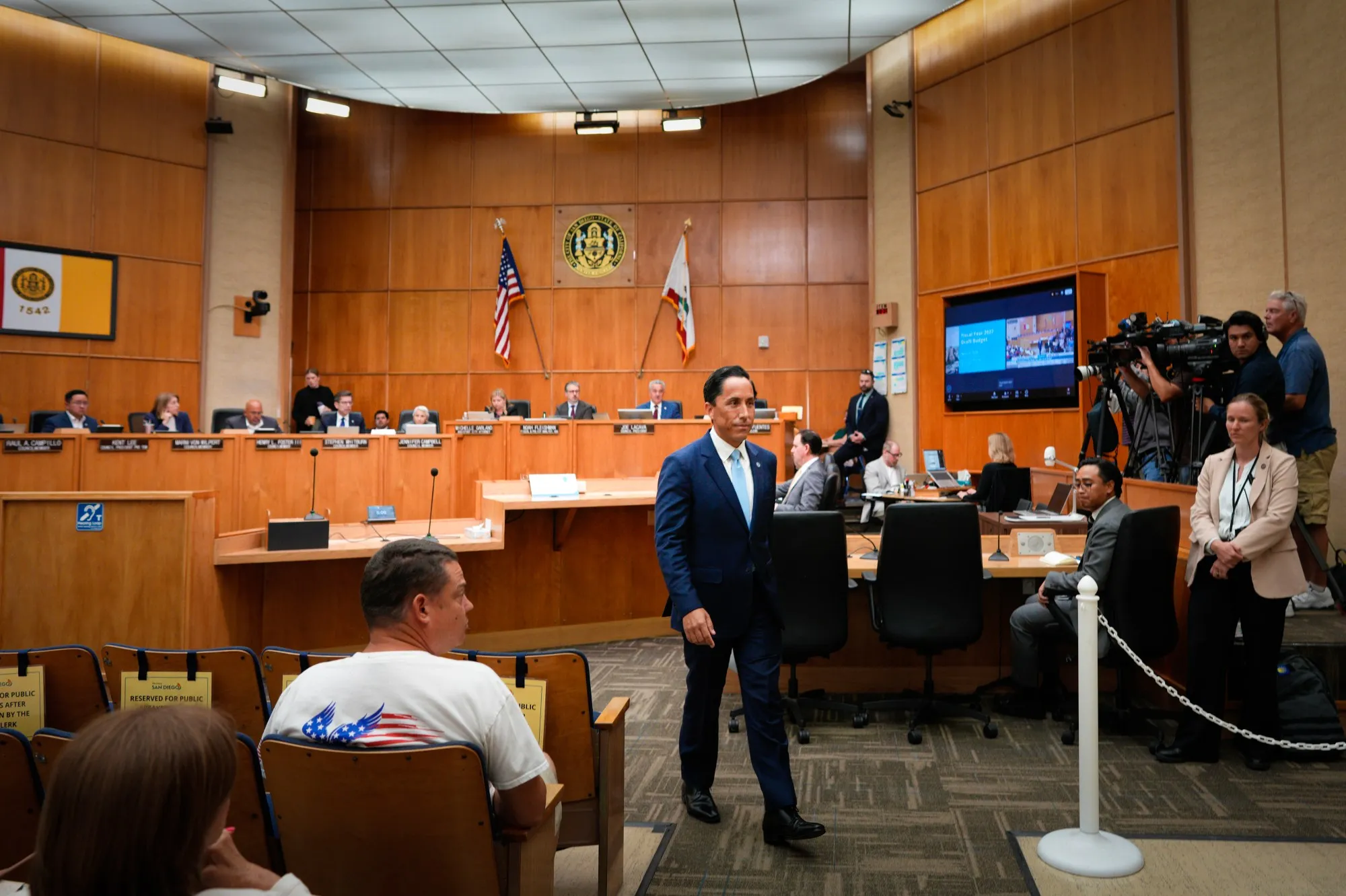
Mayor Todd Gloria has taken the brunt of criticism, and talk has surfaced — mostly in political circles — of reverting to the city-manager-style of government.
San Diego has switched between these two government structures — or debated doing so — several times for nearly 100 years. Neither has proved to be a solid solution. That’s because — surprise! — there have been good and bad decisions under both. Similarly, leadership quality has varied greatly.
As for the public, people mostly just want a city that works.
“I think for the average person on the street, they wouldn’t be able to tell one difference between a city manager from a mayor from a council from a giraffe,” Carl Luna, political science professor emeritus at Mesa College and visiting professor at the University of San Diego, said before the 2010 vote.
The mayor permanently became the city’s chief executive officer. Most municipal departments were under the mayor’s control, and he could hire and fire top bureaucrats.
Under the previous system, the mayor was a council member and had far less authority, though he or she had certain powers and advantages over other council members. The city manager was the top executive who oversaw all the departments, but was hired by — and had to answer to — the collective council.
The strong mayors had a chief operating officer — in effect, a city manager working for them. Who gets hired for that position can make a big difference
Early last year, Gloria removed his COO, the much-criticized Eric Dargan, and decided to do the job himself. But Gloria also has stumbled in executing policies that even he and the council agreed upon.
Budget moves to charge new trash-collection fees, institute parking fees at Balboa Park and close beach-area restrooms probably wouldn’t have been popular under any circumstance. But the botched rollouts triggered firestorms of protests and full or partial reversals. The recent revelation that some residents are being overcharged for trash collection only jacked up the level of outrage.
Meanwhile, budget deficits continue to loom.
The mayor’s relationship with the council in general has been strained, and downright testy with some members. Some council members have made modest attempts to wrest some power away from the mayor in recent years.
Councilmember Henry Foster, one of the mayor’s harshest critics, has talked of going further.
“Based on the neglect that I currently see, it seems the most appropriate ballot measure that should be discussed is a strong mayor form of government and potentially going back to a city manager system,” he told the Voice of San Diego in February.
He recently reiterated that view as the Foster-Gloria feud has intensified. Even if politically feasible, a ballot measure won’t go before voters until 2028, when Gloria is termed out of office.
Gloria has acknowledged the problems in his administration and the city overall, but sharply dismissed the idea that a change in government structure is the solution.
“I think this is a way to act like you’re doing something when you’re not doing anything at all,” he said in an interview, without naming Foster or anyone else. “That’s because the other things are harder.”
Read more Lofty promises have been made for a countywide sales tax hike. Here’s where the money would go.
In 1931, accusations of corruption and mismanagement were high, and San Diego voters approved replacing the strong-mayor form of government with one led by a city manager.
That held for decades, though not always smoothly. There were bribery scandals at City Hall and, at times, outrage over personal behavior. A small handful of mayors resigned; three were criminally charged.
Mayor Dick Murphy was never charged but stepped down in disgrace after city moves to underfund the pension system in the late 1990s and early 2000s. The ensuing full-blown financial scandal put San Diego on the brink of insolvency and gained national attention.
Those pension problems continue to hamstring the city budget today. While many people were responsible, the form of government at the time was oddly underscored by the names of the ill-fated pension adjustments, which were known as “Manager’s Proposals 1&2.”
City Manager Michael Uberuaga was involved in the second action and resigned along with others during a federal investigation.
Among other things that happened under city managers, there was the infamous ticket-guarantee agreement with the then-San Diego Chargers, which was subsequently seen as a bad deal for the city.
Things went differently earlier during much of the reign of Pete Wilson, who was mayor in the 1970s before being elected U.S. senator in 1982 and then governor.
He tried to shift San Diego to a strong-mayor government but failed. Instead, he, in effect, became a strong mayor through maneuvering and building alliances. Wilson had his detractors, and still does, but he showed he was a shrewd political tactician in accumulating power that wasn’t part of the job.
Sanders became mayor in a 2006 special election that followed Murphy’s exit. He had greater authority as strong mayor, but had to dig the city out of a huge hole. That required painful decisions, but by 2010 San Diegans clearly were happier with the shape the city was in and voted accordingly.
Interestingly, Wilson and Sanders essentially were both strong mayors under different forms of government.
Bob Filner, Sanders’ successor starting in 2012, quickly showed the strong-mayor system was no panacea. He stepped down after less than a year amid sexual harassment accusations and later pleaded guilty to related charges.
But even before all that, his micromanaging and combative personality at times nearly brought city business grinding to a halt.
Then-Councilmember Kevin Faulconer moved the city past many problems left by Filner. It should be noted that Gloria, then council president, had served as interim mayor and helped unclog what Filner had wrought.
Faulconer, a Republican, had great political promise in the increasingly blue Golden State. But his foray into the statewide scene petered out because of political miscues and controversies back home, including a slow response to a deadly hepatitis A outbreak and rampant homelessness.
Now Gloria, elected in 2020, holds the mantle… or the bag, depending on how you look at it. He initially didn’t think the strong-mayor concept was a good idea.
“I did not support the transition to this form of government,” he said in the interview. “I don’t think that’s the root cause of the ills to this city.
“I do think it has the accountability that people voted for,” he added.
Of that, he’s well aware.
Los Angeles Times
“Data from U-Haul suggest a generational gap in the migration: Older residents are leaving the state, while some young residents are moving around within it, hoping to build lives in California.”
Read more Climbers scale St. Louis trees during international tree climbing competition