






Downtown boosters are pushing San Diego leaders to take a consequential leap forward in the on-again, off-again effort to remake the city’s municipal compound.
Read more DHS was granted $20M for body cameras. ICE agents in fatal Houston shooting had none
In the next few months, San Diego’s Prebys Foundation and the Downtown San Diego Partnership will formally ask the city to create a joint powers authority, or JPA, with the San Diego Community College District and the San Diego Unified School District to facilitate redevelopment of the Civic Center.
The authority, as described in a draft joint exercise of powers agreement, would have all of the legal rights of the combined entities, meaning it could buy and sell land, issue bonds, enter into development contracts, oversee construction and act as a long-term steward for the redevelopment area, which currently includes the four-block quad home to City Hall and extends to two adjacent blocks.
The proposal to create what’s being called the Civic Center Redevelopment Authority was originally scheduled to be considered this week by San Diego’s Land Use and Housing Committee. The item was pulled from the agenda to give stakeholders more time to review the draft agreement, said Betsy Brennan, CEO of the Downtown Partnership. Brennan now expects the item to go to the committee in September with a request to forward a JPA agreement to the full council before the end of the year, after being vetted by the City Attorney’s Office.
The authority formation documents also require ratification by the two partner agencies.
“A JPA creates the opportunity to turn a once-in-a-generation vision for the Civic Center into a coordinated, lasting transformation that serves San Diego for decades to come,” Brennan said. “By bringing public agencies together under a shared governance structure with the ability to coordinate decision-making, align resources and pursue long-term financing strategies, a JPA provides the structure needed to turn that vision into action.”
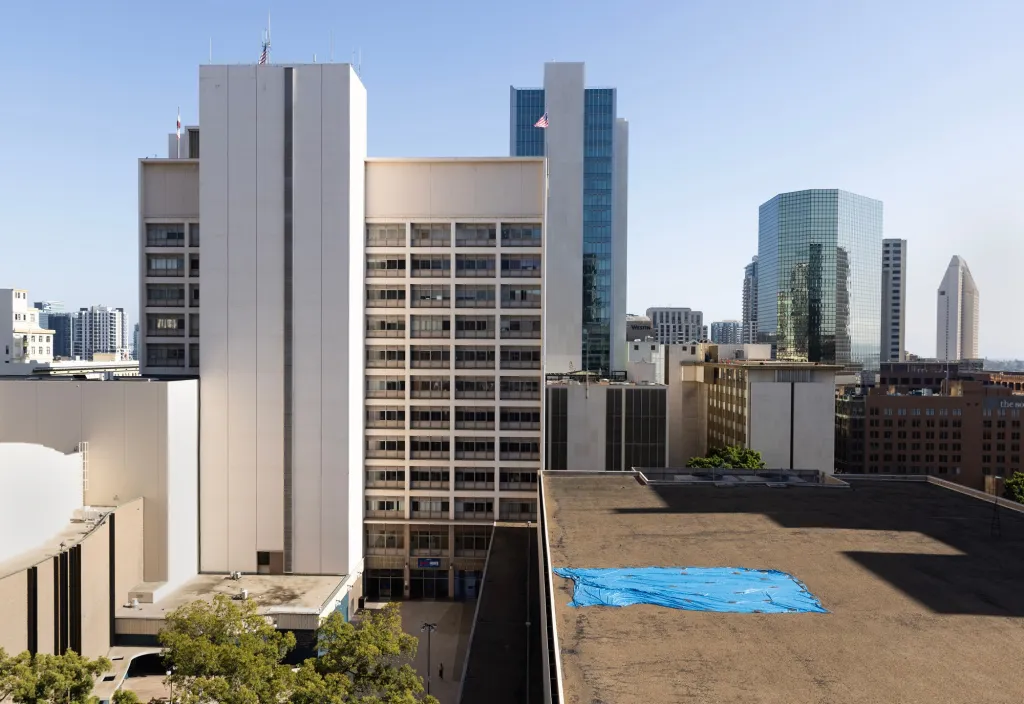
San Diego’s Civic Center is the four-block, municipal compound bounded by A Street and C Street to the north and south, and First Avenue and Third Avenue to the east and west. The quad includes the City Administration Building (aka City Hall), the Civic Center Plaza office tower, Golden Hall, the Evan V. Jones Parkade parking garage and the Civic Theatre. The proposed redevelopment area extends across the street to a fifth block at 1222 First Ave., home to the City Operations Building, and includes the block at 101 Ash St.
The blocks have been described as a dead zone in the heart of downtown with redevelopment viewed as essential to enlivening a city center further depressed by the crumbling California Theatre next door and a shuttered Horton Plaza. San Diego Mayor Todd Gloria originally sought to offload the city’s real estate to fund the construction or purchase of a brand-new City Hall before budget woes sidelined the effort.
The Prebys Foundation and the Downtown Partnership view a joint powers authority as essential to move the stalled revitalization effort forward. The philanthropic organization and the business association joined forces more than two years ago after the city’s first attempt to solicit developer interest in the real estate garnered muted interest.
The JPA proposal is meant to bring to life a redevelopment vision that was crafted by urban planning consultant U3 Advisors. The conceptual plan envisions remaking the Civic Center blocks as an arts and education hub with a world-class public space, thousands of apartments spread across multiple high-rises, shops and restaurants and a hotel.
One concrete project is already on the table. The San Diego Community College District is actively exploring razing San Diego’s aging Golden Hall event venue and replacing it with a museum and educational center, and student housing.
“The city has the land, but not necessarily the financial resources,” Brennan said. “The (community college district) already has the resources and is ready to go, and wants to do this redevelopment project. The San Diego Unified School District is hopefully on that same track with their November bond measure. … So we wanted to have a government structure that allows those entities to work together and always go back to their governing boards when necessary.”
The current version of the joint exercise of powers agreement of the Civic Center Redevelopment Authority was drafted by the law firm Best Best & Krieger LLP and modeled after the structure of the Transbay Joint Powers Authority in the Bay Area, she said.
As written, the JPA would be governed by a five-person board comprised of two directors appointed by the city of San Diego, two directors appointed by the San Diego Community College District and one director appointed by the San Diego Unified School District. The board members would serve four-year terms.
The governing body would have the power to set agency bylaws, acquire property, exercise eminent domain, approve development agreements, issue debt, enter into contracts, adopt annual budgets, certify environmental impact reports and admit new members.
Read more How to stay safe and still enjoy produce this summer with the outbreak of diarrhea-causing parasite
However, San Diego would need to separately transfer the Civic Center blocks to the JPA before the entity could exercise land-use authority over the real estate.
“(The joint exercise of powers agreement) is just a document, just a piece of paper,” Brennan said. “The JPA is a legal entity that doesn’t really do much until it has land that it is in charge of.”
As proposed, the JPA’s board would also have the power to delegate operational authority to an administrator, likely an independent nonprofit created specifically to handle day-to-day tasks associated with the real estate.
Brennan said the Downtown Partnership and the Prebys Foundation expect to form the nonprofit, which will have its own board with directors from the organizations. The partners said previously that the nonprofit would essentially act as the land developer, coming up with a master plan, securing permits, managing financing, entering into contracts with partners and overseeing construction.
Real estate analyst Gary London said the joint powers authority could be an effective way to bypass the city’s slow-moving bureaucracy — but only if it functions with the same level of power as the city’s former redevelopment agency.
The city’s former redevelopment agency, working through Centre City Development Corp., helped orchestrate the development of Horton Plaza, the San Diego Convention Center and Petco Park, and used tax increment financing to pay for much of the infrastructure. Redevelopment agencies were, however, dissolved by the state in 2012.
“It sounds like CCDC. The state stupidly put to sleep redevelopment authority, and now downtowns across the state are failing. … Thank goodness there’s some kind of a structure that can resuscitate a de facto redevelopment agency,” said London, principal at London Group Realty Advisors. “It would be wonderful because right now downtown is a decision-making rigor mortis, and the market is failing.”
At the same time, London believes the Civic Center focus should be shifted to a much bigger problem area south of Broadway through Horton Plaza. The area, or the historical heart of downtown, is suffering from vacant storefronts, crime and neglect, he said.
“The right question shouldn’t be focused on what do we do with the Civic Center,” London said. “What they should saying is, ‘How should we use the Civic Center as an asset to revitalize the really important parts of downtown,’ which is everything south of the Civic Center through Horton Plaza. That’s the crisis area that needs to be resuscitated.”
The analyst said he hopes the JPA discussion will serve as a wake-up for the city to reconsider a deal to buy a portion of the vacant Horton Plaza campus for city offices.
The draft JPA agreement acknowledges the underlying tension around the authority’s intent to redevelop real estate that is in active use.
“Without limiting the foregoing, the authority shall not require the relocation or removal of City Hall or otherwise take any action that would materially interfere with the city’s continued governmental operations at City Hall unless and until the city determines that appropriate replacement facilities or other suitable accommodations are available or otherwise consents in writing to such action,” the document states.
A consultant’s report released earlier this year, which initially recommended the formation of the JPA, also called for the city to make a final decision this year on whether it wants to remain at City Hall or relocate elsewhere.
Read more Charles hosted Prince Harry and family for first time in years as they try to repair a family rift