






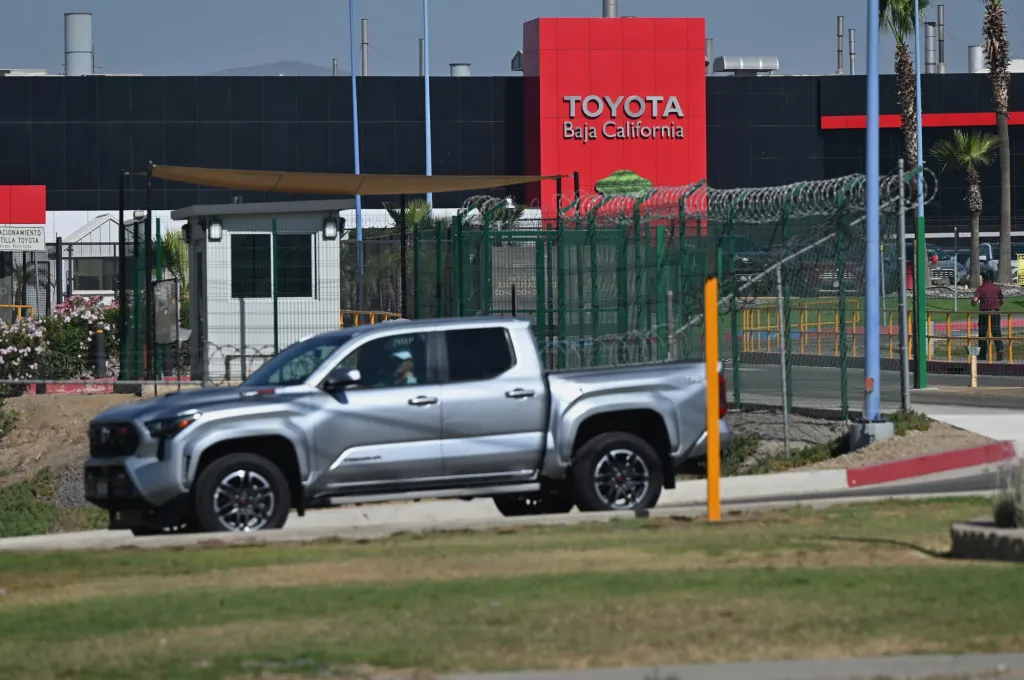
Outside of Toyota’s 700-acre Baja California manufacturing facility last week, trucks were loaded with Tacoma pickup trucks bound for the U.S. border. It’s a common sight in this commercial area of eastern Tijuana, but one that will gradually change over the next four years.
Read more The next big races between moderates and progressives are in pivotal Midwestern states
Last week, Toyota announced that it will move Tacoma production from its Baja California plant to Texas as part of a $3.6 billion expansion project at its San Antonio manufacturing campus. The plan is expected to create 2,000 new jobs for the state.
In a Truth Social post, President Donald Trump praised the decision, calling it “a really big deal,” and credited the move to tariffs imposed by his administration.
But in Tijuana the announcement has caused confusion and uncertainty. Some are calling for patience as they await further information about the company’s plans after the move. The announcement has also spurred business leaders and government officials to begin work on ways to lessen the potential impact on the border state.
“We took the news with caution, but very seriously,” said Alfonso Millán of the Baja California chapter of the National Chamber of Freight Transportation. He represents the company that transports hundreds of Tacomas to the U.S. every day.
The Toyota Motor Baja California manufacturing facility, the Japanese automaker’s first full-scale operation in Mexico, opened in 2004. By 2019, the plant was estimated to employ more than 2,000 people and produce 166,000 units annually.
The facility, located along the Tijuana-Tecate highway, manufactures the popular Toyota Tacoma, the best-selling mid-size pickup in the U.S. Operations include body welding, painting and assembly, according to the company website.
“It’s been a great achievement to have the plant here,” Millán said. “I’d be a little more cautious about what to expect going forward. As of now, the plant has been a model of efficiency, hard work and prompt deliveries.”
Toyota is the only manufacturer of passenger vehicles in the region, while Kenworth produces heavy trucks at its manufacturing plant in Mexicali.
Mexico’s Secretariat of Economy issued a news release saying the company had informed the government of the decision “as part of a process to restructure its global operations.”
“The relocation of production will not happen immediately but rather as a gradual process completed by 2030,” Mexican officials said, adding that the company is “continuing to assess the plant’s future” beyond that date.
Mexico said that the company will keep its manufacturing plant in Guanajuato, where Tacomas are also made. That plant employs 2,800 people.
A Toyota spokesperson said that Tacoma production in Baja California will continue as normal during the transition. However, it is unclear what will happen afterward.
“There are no future product announcements at this time,” the spokesperson added. “Toyota is maintaining its operations in Mexico.”
On Wednesday, a worker outside the Tijuana facility said it was a good place to work and that, although she felt somewhat safe for now, she said she wasn’t sure about the future.
Read more Judge blasts Trump’s IRS lawsuit as filed for ‘improper purpose,’ recommends attorney discipline
Toyota’s announcement comes shortly after the United States announced that it would not renew the North American free trade agreement in its current form and instead has opted for annual reviews. Negotiations are still ongoing, with a third round of talks with Mexico scheduled for next week.
Automakers are especially impacted. Currently, some vehicle imports face a Trump-imposed tariff of up to 25% on their non-U.S. content.
Amid the uncertainty, some business leaders and researchers in Baja California believe it is time to plan for what comes next.
“We’re going to develop a strategy to mitigate the impact; these are decisions we cannot change,” said Octavio Sandoval, president of the Baja California Business Coordinating Council.
Toyota addressed the trade deal in its news release, stating that it “encourages a quick resolution to USMCA to make the North American region globally competitive.”
The timing of Toyota’s move could be seen as a “wake-up call,” said Elisa Ibañez, president of the Tijuana chapter of Mexico’s Employers Confederation, better known as Coparmex.
“We see this as a great opportunity for Mexico to promote policies that will help keep these companies,” she said.
Ibañez noted the jobs and investment Toyota brought to the region. “It’s a very important brand,” she said. “Companies tend to locate where other companies are, bringing their suppliers with them. We need to be mindful of that impact, and we can’t downplay it. We need to pay attention to that warning.”
Data from Index Tijuana, an organization representing export-oriented sectors, estimates that the manufacturing industry generates approximately 400,000 direct jobs in Baja California.
Ismael Plascencia, coordinator of the business administration program at CETYS University in Tijuana, argued that Mexico should not depend solely on the United States for exports. It is estimated that over 80% of Mexican exports head to the United States.
“Mexico needs to seek diversification,” he said. “That doesn’t mean antagonizing the United States. However, if we see that they aren’t treating us fairly as a trading partner, the smartest thing we could do is develop our own industrial policy and diversify our markets.”
Plascencia estimates that Toyota’s decision could indirectly lead to an additional 2,000 job losses in Baja California among its suppliers. “The implications are significant because the jobs are well-paid. People earn more in the automotive sector than in other industrial sectors,” he said.
He said that Baja California should continue investing in and strengthening industries such as medical devices, aerospace and health care services while considering other emerging industries of the future.
“Instead of seeing things in black and white because Toyota is leaving, which is a strong blow,” he said, “we should continue to strengthen the other areas where we can develop value chains together with California, San Diego and Tijuana because, in the end, we are a metropolis that competes globally.”
Read more Minnesota was center of immigration enforcement. Here’s how it’s playing out legally.