






A new state law that requires San Diego to allow high-rise housing near trolley stations and major bus stops will force the city to allow even more new homes than the 367,000 that city officials predicted this spring.
That’s because San Diego is being forced to change zoning near five times as many bus stops as city officials had deemed qualified under the new state law, SB 79.
City planning officials had said that only four bus stops qualified for SB 79, which allows buildings as tall as 85 feet in areas otherwise zoned for single-family housing.
But the city was overruled last week when the county’s regional planning agency – the San Diego Association of Governments – declared that 21 bus stops within the city meet the criteria of the new law.
That’s in addition to 47 trolley stations that no one disputes are eligible for SB 79.
City officials say they’re still trying to figure out how the bus stop ruling will affect their predictions of many new homes SB 79 will force them to allow, but housing advocates estimate the additional bus stops will increase the number by about 100,000 — from 367,000 to roughly 467,000.
Four city council members who criticized the city’s plan to include only four bus stops say they would like to see SANDAG go even further and include more bus stops before the list gets finalized this summer.
The council members – Stephen Whitburn, Vivian Moreno, Kent Lee and Sean Elo-Rivera – say the disputed stops make sense for SB 79 because they are part of the city’s urban core in communities such as Hillcrest, North Park and City Heights.
“They are exactly where we should be building housing, in our most urbanized areas: near transit, near jobs and near the amenities that make neighborhoods livable,” the foursome said in a letter to SANDAG last week.
They praised SANDAG’s list of stops, which is featured on a map the planning agency posted to its website just a few days before SB 79 took effect on July 1.
But they said even more stops should be included.
“While we are encouraged by the stops included in the draft map, we respectfully request that SANDAG ensure full inclusion of all qualifying stops along Routes 1, 7, 10, and Rapid 215,” the four wrote. “Partial inclusion leaves gaps that would result in uneven application of SB 79 along corridors that are continuous and consistently served by dedicated bus lanes.”
Locally, the bus stops have become the most controversial element of a law that was already making waves because of its potentially transformative impact on cities – especially cities with lots of transit options.
Many community leaders and local officials downplayed the effect of SB 79 on San Diego when it was approved last October because the city had already done significant upzoning near many of its trolley stops, especially in University City, Mission Valley, downtown and Little Italy.
The city also already offers an aggressive incentive to spur housing near transit. Complete Communities Housing Solutions allows developers to build significantly larger projects than a site’s zoning would otherwise allow as long as they include subsidized units.
But SB 79 will still have a major impact on San Diego, primarily because the Complete Communities program and some other incentives don’t apply in single-family areas — but SB 79 does.
In addition, many of San Diego’s trolley stops are in City Heights, the South Bay and southeastern San Diego neighborhoods where the city has done significantly less upzoning in recent years — and where much of the land is zoned for single-family housing.
This spring, San Diego officials said SB 79 would require the city to nearly double the number of housing units allowed near its major transit stops, from the 494,000 now allowed to 861,000, an increase of 367,000 housing units.
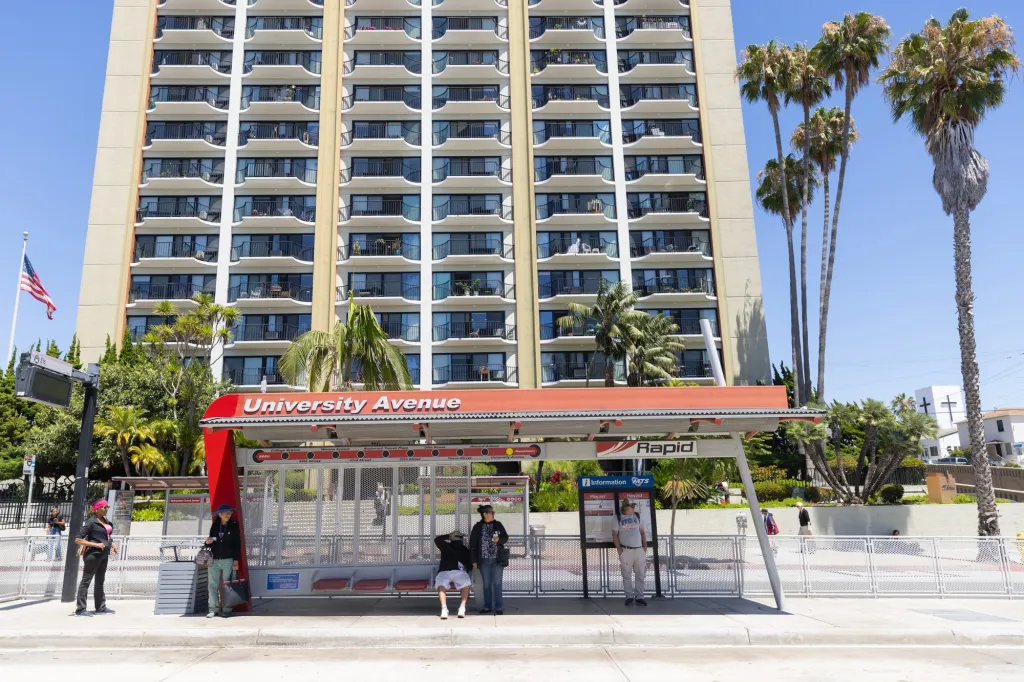
But that was with only four major bus stops: Park Boulevard at University Avenue, Park Boulevard at Howard Avenue and two transit plazas – one where Interstate 15 intersects with El Cajon Boulevard and another where I-15 intersects with University Avenue.
City officials declined last week to provide a revised estimate.
“The City Planning Department is currently evaluating the newly released SANDAG map to determine the resulting increase in housing capacity,” said Peter Kelly, a spokesperson for the city Planning Department.
But the YIMBY Democrats of San Diego County, a group that advocates for high-rise housing, estimates that the city will need to increase the number of housing units by roughly 100,000 – so a total of ]about 467,000.
Both city officials and the YIMBY Dems agree the number will come down a bit because some of the units allowed by SB 79 are also allowed by Complete Communities – meaning some units are being double counted.
The YIMBY Dems played a key role in spurring the controversy over bus stops this spring when they declared, with detailed evidence, that the city was dramatically underestimating the number of bus stops eligible for SB 79.
Read more Michael Smolens: San Diego, California push subsidies for affordable housing
City officials chose to include only stops with bus lanes that couldn’t be used by cars or bikes, but the YIMBY Dems argued that SB 79 was not that restrictive regarding which bus stops are eligible.
The YIMBY Dems argued that San Diego should have included 52 bus stops. But it’s important to note that city officials and the YIMBY Dems count bus stops differently.
The city counts a location with bus stops on either side of the street – for buses that travel opposite directions – as one stop. The YIMBY Dems count that as two stops.
So the group was essentially arguing that the city should include 26 bus stops instead of four bus stops.
The YIMBY Dems convinced enough council members that city planning officials were wrong about the number of bus stops that the council voted in May to wait for SANDAG, which has the final say anyway as the region’s lead planning agency.
The list SANDAG released last week mostly vindicates the YIMBY Dems.
“I feel great that things went our way,” said Zack Defazio-Ferrell, an attorney who serves as treasurer of the YIMBY Dems.
Kelly, the city spokesperson, blamed the discrepancy on SANDAG getting additional guidance from the state in recent weeks.
“The City Planning Department’s maps presented at the City Council reflected SANDAG guidance at the time they were prepared,” Kelly said. “As we understand it, SANDAG has since received additional guidance, resulting in the inclusion of additional stops in its draft map.”
DeFazio said city officials shouldn’t be criticized.
“I don’t think city officials really understood the law – a lot of people don’t,” he said. “It’s a confusing law in many areas.”
DeFazio said he believes there are errors on the SANDAG maps, despite them mostly vindicating his group.
He said some of the stops included are similar to stops that were excluded, contending the excluded stops should get added to the list.
The 17 stops SANDAG included beyond the four the city had deemed eligible are: Park Boulevard at Inspiration Point Way, Naval Hospital, and Zoo Place; Broadway at Third Avenue and Fourth Avenue; University Avenue at Louisiana Street, Herman Avenue, 30th Street, Iowa Street and I-15 Centerline Station; El Cajon Boulevard at 30th Street, Texas Street, Utah Street, Oregon Street, 43rd Street and I-15 Centerline Station; and Gilman Drive at Mandeville Lane.
Many of the additional stops the YIMBY Dems are lobbying for are located on Clairemont Mesa Boulevard, Genesee Avenue, downtown and along University Avenue in western Hillcrest.
SB 79 allows larger buildings the closer the property is to a transit stop. On property within 200 feet of a stop, a project can include 140 units per acre and be up to 85 feet tall.
On land more than 200 feet away but within a quarter mile of a stop, the project can include 100 units per acre and be up to 65 feet tall. On land between a quarter-mile and a half-mile away from a stop, the project can include 80 units per acre and be up to 55 feet tall.
The YIMBY Dems sent a joint comment letter to SANDAG last week with BuildSD and Circulate Planning and Policy.
In addition to lobbying for more bus stops to be included, the letter says SANDAG has not properly categorized the Solana Beach Coaster station and the Oceanside Transit Center, downplaying how many housing units need to be added in those places.
A SANDAG spokesperson declined to respond to the letter.
The spokesperson, Stacy Garcia, also declined to say whether the SANDAG board will approve the list of stops or whether the list will be finalized by staff without board approval.
Instead, she provided a statement from the agency.
“The draft map was developed based on current statutory requirements and is shared with local jurisdictions and the public,” the statement says. “We expect to finalize the map in the coming weeks.”
The San Diego City Council voted in May to use its discretion under SB 79 to delay the impact of the law in many parts of the city.
The delay affects low-income areas with scant resources and other neighborhoods facing challenges like high wildfire risk, historic structures or vulnerability to sea-level rise.
Read more Rescue teams in Venezuela cling to hope as US rebuffs criticisms of government earthquake response