




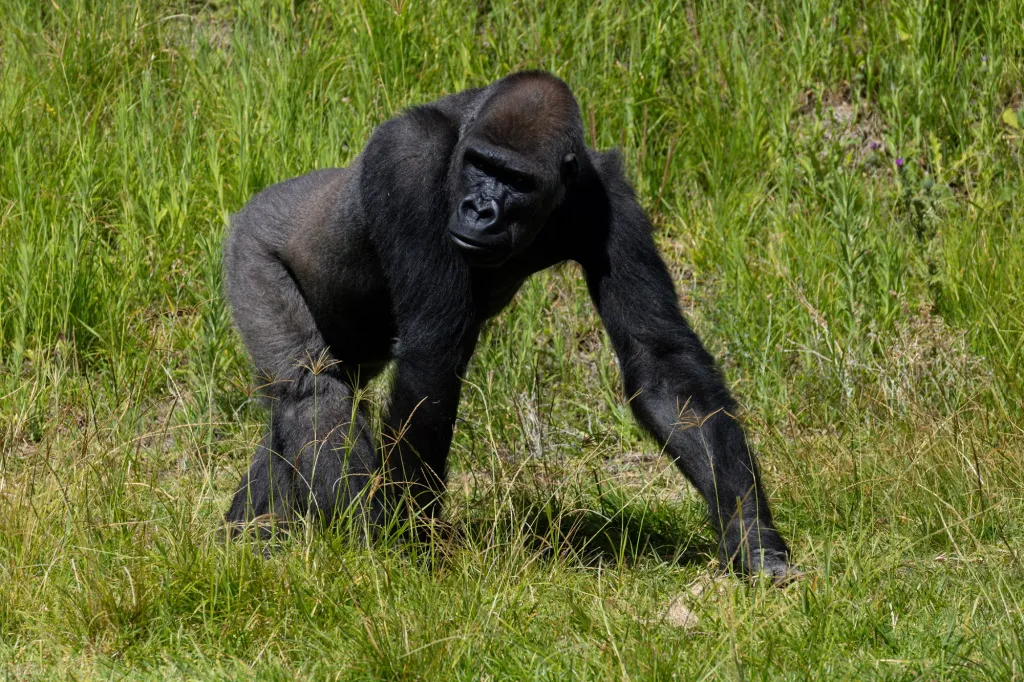
The 12-year-old gorilla at the San Diego Zoo Safari Park seemed to struggle to open his mouth. Mizani avoided eating and often held his head up while squinting his eyes, indicating head pain.
Read more ‘Pacific Beach Rapist,’ who attacked women in the early ’90s, denied parole
Concerned, park staff conducted a scan of his head and confirmed the diagnosis: Mizani had sinusitis and mastoiditis, an infection of the large bone behind the ear, which can also occur in people.
Ryan Sadler, senior veterinarian at the San Diego Zoo Safari Park, said the situation called for “truly an emergency surgery.” If not treated, he said it could result in hearing loss and facial paralysis or progress to life-threatening conditions such as sepsis. But a surgery like this had never been reported to have been done on a gorilla.
So on Friday, they contacted UC San Diego Health.
The partnership resulted in the world’s first reported mastoidectomy — the removal of a chronic ear infection — on a gorilla.
“My first thought is how urgent is this?” said Jeffrey Harris, the division chief of otolaryngology – head and neck surgery at UCSD. “This is an emergency, and we shouldn’t let too many suns set before we evacuate this infection.”
After the call Friday afternoon, Harris began researching everything there is to know about a gorilla’s anatomy before the operation Saturday morning.
Because humans and gorillas share some anatomical similarities, Harris and Kris Suresh, a resident fellow at UCSD Health, adapted human medicine techniques to perform the surgery on Mizani. Robin Boyington, a scrub technician, assisted them during the procedure by handing them medical instruments. They regularly perform skull and ear surgeries — but on people.
While Harris said he’s researched animal anatomy, the extent of his experience with animal surgery was an endoscopy — an examination of internal organs — on a koala. So, when he got the call, he said, “let’s find out as much as we can about gorillas, and let’s get it taken care of.”
Harris said his team brought all the necessary medical equipment with them to the surgery, which took place at the Harter Veterinary Medical Center at Safari Park, and it lasted about five hours.
Read more Drained Reflecting Pool reveals Trump’s ‘American flag blue’ liner is now closer to gray
The procedure included an incision on the left side of Mizani’s head and removal of infected mastoid bone and tissue parts. More than 20 veterinarians, physicians, registered veterinary technicians and wildlife care specialists were involved, according to the San Diego Zoo Wildlife Alliance.
A big difference between a gorilla’s and a person’s mastoid — the bone behind the ear — is that a gorilla’s is enormous. Harris said his biggest concern was making sure he knew where Mizani’s facial nerve was to avoid it; otherwise, it could seriously injure him.
But it was a success. Mizani has shown signs of improvement, as exams reveal that the infection was removed, zoo officials said.
“This is absolutely one of the most gratifying things I’ve ever done,” Harris said.
Sadler, the veterinarian, said this disease is rare among gorillas. Wildlife care experts said they believe he developed the infection before he arrived at the zoo in November 2024.
“Even after working with gorillas throughout my career, I’m still learning something new every day,” Sadler said in a statement. “Procedures like this highlight how medicine can be remarkably similar across species, while also requiring very different approaches depending on the animal.”
Mizani is back to eating normally, zoo officials said. He will continue to be monitored and is scheduled for another exam in a year.
In August, Harris is traveling to the Netherlands to present the experience as the first mastoidectomy surgery on a gorilla. He also has four lectures in India in October, during which he said the surgery may also be brought up.
Read more CDC nominee says she won’t betray science — and also backs Kennedy’s actions