





Construction funding is about $60 million short of what’s needed to replace a crumbling, 99-year-old, concrete-and-steel bridge that provides the only access to the Oceanside Municipal Pier, city officials said.
Read more Backlash, consequences growing against San Diego’s poster child for ADU exploitation
So far, the city has spent about $9.7 million planning the Pier View Way bridge project and has set aside an additional $12 million, said City Engineer Brian Thomas, in a September presentation to the Oceanside City Council. However, the total cost is expected to be about $82 million.
Meanwhile, preparations are underway for a separate project to repair the fire-damaged hammerhead section at the end of the pier beginning as soon as next spring.
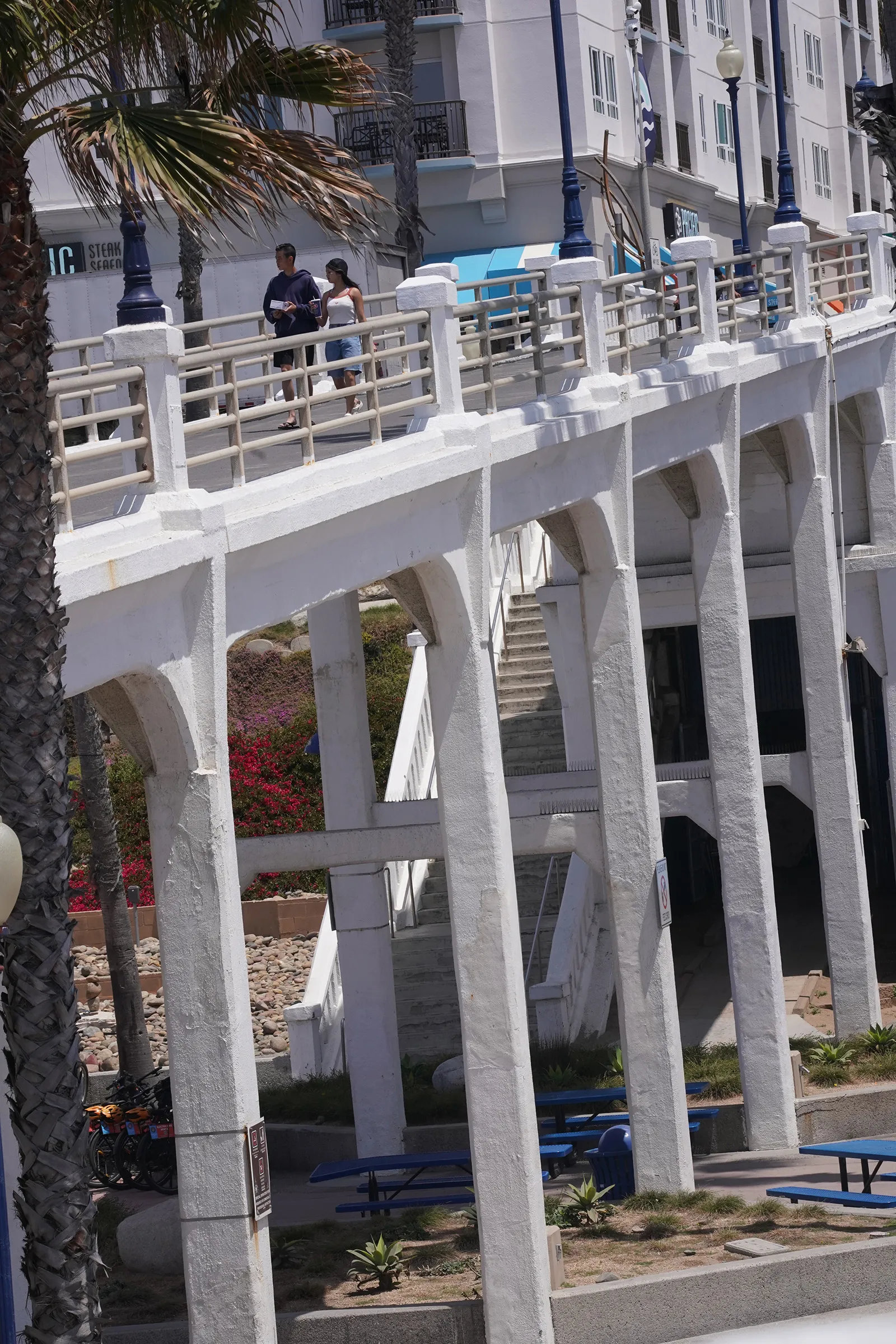
The picturesque white bridge to be replaced crosses a beach-level street called The Strand and carries pedestrians between the bluff-top Pacific Street and the wooden portion of the pier. The spalling concrete span has been repaired and reinforced multiple times, but still fails to meet building codes and continues to deteriorate.
A consultant’s study in 2018 confirmed that the concrete bridge failed to meet current seismic and structural design standards. The city’s public works director at the time said the bridge was safe to remain open for pedestrians, but a complete seismic retrofit was needed.
The bridge includes a pedestrian ramp up from The Strand to the pier. It also has a building beneath the deck that once was a public dining hall and now houses the city’s lifeguard headquarters.
Saltwater has permeated the old structure over the years, corroding the steel reinforcement bars and causing whole chunks of concrete to fall off. A large piece from an interior ceiling landed on a lifeguard administrator’s desk in 2021, according to reports.
Finding money for a new bridge, along with other needed beachfront improvements, has been a challenge.
“Grant funding opportunities continue to be challenging because the concrete portion of the bridge does not carry vehicular traffic,” Thomas said. “Therefore, it is not eligible for Caltrans or (Federal Highway Administration) grants or funding.”
City officials are considering other possible sources such as Proposition 4, which California voters passed in 2024 to provide money for parks, outdoor recreation and adapting facilities to climate change.
“This is a very critical project for the city of Oceanside,” said Mayor Esther Sanchez.
The plans were developed with public input from a series of community meetings. Rather than renovate the bridge, the consensus was to demolish the existing structure and rebuild a longer-lasting one that looks much the same.
“This is the end of a long process that took lots of formal public meetings and lots of input from very passionate residents,” said Councilmember Eric Joyce. “I know they are eager to give (the bridge) a fresh look … I’m looking forward to getting it done.”
The pier has a sentimental value for many families, some of whom have walked or fished there for generations. Aside from that, it has a long and significant history as one of the city’s greatest attractions.
Oceanside has had a public pier since 1888. The concrete portion of the present-day pier was built in 1927, but the wooden part has been rebuilt several times since then. The existing, nearly 2,000-foot-long version was built in 1986 to replace one ruined by winter storms.
A fire in April 2024 destroyed a vacant two-story restaurant and a smaller building on the wider portion known as the hammerhead at the end of the pier. Since then, the end of the pier has been closed to the public.
An investigation by the federal Bureau of Alcohol, Tobacco, Firearms and Explosives’ Bomb and Arson Tracking System determined the fire to be accidental. The ATF report said an electrical source appeared likely, but did not specify the cause.
The city plans to hire a contractor to install 22 temporary cable braces this fall that are needed to support the deck during the repairs, Thomas said.
Read more Four candidates vie for National City mayor as budget shortfall, council division shape race
However, a call for bids to install the braces ended Sept. 14 with only two offers and both were above the city’s estimated cost of $150,000 to $220,000, he said. One bid was $278,000 and the other was $880,000. Because both bids exceeded the anticipated range, the city staff will forward the contract to the City Council to consider at its meeting Oct. 21.
“Efforts are on-going to develop construction documents and obtain necessary regulatory permits for the restoration of the Pier hammerhead,” states a weekly update sent to the City Council on Thursday.
The city’s losses in the fire are covered by an insurance program called PRISM (Public Risk Innovation, Solutions and Management). The restaurant tenant has private insurance to cover that portion of the loss, city officials said.
The city’s most recent estimate to repair the fire damage was $17 million. The estimate excludes the cost of rebuilding the restaurant, formerly occupied by a Ruby’s Diner, and the smaller building, a kiosk called the Brine Box that was selling take-out food when the fire occurred.
“Other than the initial payment received to help cover some of the demolition costs, the City has not yet received any other insurance payment,” Thomas said in an email in March.
“That payment will be predicated on the actual cost to restore the hammerhead section of the Pier to its former state,” he said. “The amount will be determined once we have a final design cost and an award amount for the reconstruction work.”
As of mid-September, the design for the repairs was about 50% complete, Thomas said. Applications for regulatory permits and lumber procurement were underway, which can take three to six months.
“The lumber is going to take a long time to come from the Pacific Northwest,” Thomas said at the City Council’s meeting Sept. 16.
Replacement of the deck and railing on the hammerhead is scheduled to begin in the spring of 2027 and take about eight months with a break for the tourist season from the end of May to the beginning of September, Thomas said. The restaurant will be rebuilt later.
“Our goal, at the end of the day, is to open the end of the pier to the public, while the future restaurant is being designed and permitted,” he said.
The pier bridge and lifeguard headquarters replacement is proceeding in parallel with other nearby beachfront improvements that also are well into the planning stages, but largely unfunded.
Those include the renovation of the Junior Seau Beach Community Center and the replacement of the Junior Seau Pier Amphitheater and Bandshell. The facilities host some of the community’s best-loved cultural, athletic and theatrical events.
The city’s first bandshell was built in 1919 and the present version dates to 1950, according to a blog by Oceanside historian Kristi Hawthorne. The stadium-style seats of the amphitheater were added in 1937, and the community center went up in the 1950s.
Also being considered is the proposed development of a 111-space parking area known as Betty’s Lot, just south of the bandshell and amphitheater on The Strand. Planners have discussed adding a second level to the lot with outdoor courts on top for basketball, volleyball or pickleball, along with indoor classrooms and storage space.
A city consultant in 2022 estimated construction costs for those projects at $11.4 million for the community center improvements, $31.7 million to rebuild the amphitheater and bandshell, and $36.2 million for the Betty’s Lot roof-top park.
All construction along The Strand is limited by local Proposition A to no higher than the nearby Pacific Street, which runs parallel to The Strand at an elevation of about 30 feet. Oceanside voters approved Prop. A in 1986 to preserve downtown ocean views.
The city has been working on its beachfront improvement plans since at least 2020.
Read more Stayin’ Alive: San Diego County trains more than 1 million in bystander CPR